
As an Amazon Associate I earn from qualifying purchases.
Outdoor electric lamp posts can serve quite different projects. You might be replacing a lantern on an existing post, adding a complete light pole to a driveway, or placing a portable decorative lamp beside patio seating. Choosing the wrong installation form can turn a promising purchase into a much larger project than expected.
The five options below cover those different roles. They are compared using their selected product information, with no claim of hands-on testing or measured light coverage. After the product notes, the buying guide helps you assess mounting, bulbs, controls, power access and the complete project cost. Establish those requirements before deciding which traditional lantern style you prefer.
Start with the installation form
- Lantern for an existing support: Windben supplies a post-light fixture and pier base, rather than a tall pole.
- A three-head lamp-post arrangement: PARTPHONER is listed as a complete tall post with three included LED bulbs.
- A hardwired light with dusk-to-dawn control and an outlet: check the selected SCNYCUL configuration and its installation instructions.
- A portable decorative floor lamp: Kenroy Villa uses a weighted base and can serve a different role from fixed driveway lighting.
- A three-head hardwired post with selectable sensor modes: Redluck adds an outlet explicitly described in its listing as GFCI.
A product being electric does not establish whether it plugs into a receptacle or needs permanent wiring. Nor does a lantern photograph prove that a post or foundation is included. Review the actual package and manual with the installer before budgeting for the site.
The five electric lighting options
Windben: post lantern and pier base
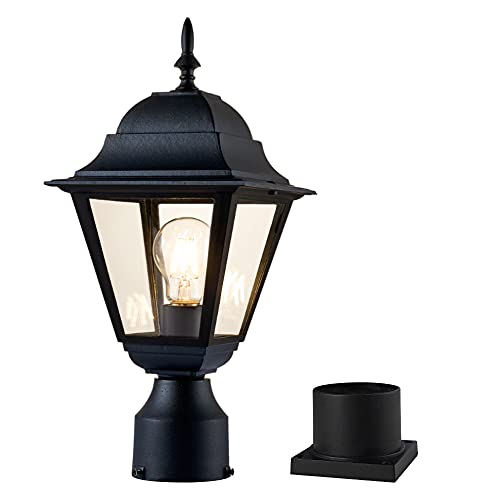
The matte-black Windben fixture is aluminum with clear tempered-glass panels. The listing gives an outside lantern size of 7.4 inches by 7.4 inches by 16.5 inches, a pier-base side length of 3.5 inches, and a 110–120-volt rating. It uses one E26 bulb with a stated maximum of sixty watts; the bulb is not included. The package is described as the light, pier base and manual.
Consider it when your project already has an appropriate support or when the installer will provide one. Its sixteen-and-a-half-inch height describes the fixture, not a complete garden pole. The outside pier-base dimensions do not establish the pole diameter or bolt spacing required for your existing mounting point.
Before choosing: compare the manual’s mounting details with the actual support. The seller describes wet-location outdoor use, but suitability should be confirmed from the delivered label and instructions. This guide does not independently verify a certification listing or repeat the seller’s claim of eliminating electrical risk.
Check the selected light on Amazon
PARTPHONER: traditional three-head post

The selected black PARTPHONER is a three-head design in aluminum and glass. Its listing describes a height of approximately 7.1 feet and an overall width of approximately 1.8 feet. Three six-watt LED bulbs are included, with E26 sockets. The listing describes a maximum of one hundred watts per socket; use the actual fixture labels and bulb-compatibility directions when choosing replacements.
This is a more substantial visual feature than a single lantern mounted on a low pillar. Mark both its height and head spread on the proposed site, including space around nearby planting. The number of heads does not establish how evenly it will illuminate a particular driveway.
Before choosing: confirm the supply connection and installation requirements with the manual. The listing uses the phrase corded electric, which should not be interpreted as proof that a ready-to-use wall plug is provided. This selected model is not described here as the separate outlet-equipped version shown elsewhere on its product page.
Check the selected light on Amazon
SCNYCUL: dusk-to-dawn control with an outlet

The SCNYCUL listing selects the XL-1-H configuration and describes a hardwired black lamp post with an outlet and a dusk-to-dawn sensor. It specifies aluminum and glass, an E26 socket and a sixty-watt maximum bulb rating, with the bulb not included. A light-sensitive control is different from a motion detector: this model is compared for dusk-to-dawn operation.
The outlet can be a reason to consider this configuration, but the observed product information does not establish that it is a GFCI receptacle. Have the installer verify the required protection and the outlet’s permitted use. An outlet pictured on the pole is not enough to determine its electrical rating, protection or control behavior.
Before choosing: obtain the exact assembled dimensions and mounting details for XL-1-H. The page contains multiple configurations, so measurements or features from another size should not be transferred to this one. Confirm whether the outlet remains powered under the intended switching arrangement rather than assuming it operates independently of the lamp.
Check the selected light on Amazon
Kenroy Villa: portable decorative outdoor lamp

The Kenroy Villa page currently selects the one-head style in an oil-rubbed-bronze finish. Its general heading also refers to a two-light variant, so confirm the selected package with the seller before ordering. The selected specifications describe a portable outdoor floor lamp approximately seventy-one inches high and thirteen inches wide, with a weighted base and a light switch.
The practical distinction is portability. This option may suit a patio seating area where the supplied connection, surface and placement requirements can be met. It should not be treated as a fixed post that includes a ground anchor or a driveway foundation system.
Before choosing: confirm the exact head count, electrical connection, permitted bulb and outdoor-use instructions for the ordered variant. A weighted base is not a wind-speed rating, and this guide does not promise stability in severe weather. Include the cord route and base footprint in the layout rather than evaluating only the lantern above.
Check the selected light on Amazon
Redluck: three-head post with motion and lighting modes
The selected black Redluck is the 94.85IN three-head hardwired configuration. Its listing explicitly identifies a built-in GFCI outlet, motion operation, dusk-to-dawn operation, a continuous-on mode and a test mode. It uses three E26 bulbs that are not included. The seller states a maximum motion range of thirty-five feet, which should not be treated as guaranteed detection across every site.
Consider this option when its control choices serve a defined need. For example, you may want motion-triggered light at an approach rather than continuous overnight illumination. Review the selected manual’s setup and bulb requirements, and assess whether your proposed location gives the sensor a useful view.
Before choosing: have the installer confirm the outlet rating, supply capacity, required protection and control behavior. Do not assume that its outlet can power every garden appliance. The listed modes offer different operating choices, not a guarantee of security or a measured reduction in electricity use.
Check the selected light on Amazon
Buying guide: plan the light before buying the post
Write down the area you want to serve
Describe the main job in a sentence: lighting a front approach, adding a decorative feature by a garden path, or creating ambient light near seating. A large post that looks attractive by a driveway may be excessive beside a small table. Keep the purpose specific so you can compare form and controls sensibly.
Sketch the proposed location in relation to the entrance, parked vehicles, planting and neighboring windows. Include the view from inside your home. This exercise does not calculate light coverage, but it can reveal a placement that blocks movement or creates an unwanted visual focal point.
If reliable illumination of a particular task or route is essential, ask for suitable light-output and distribution information or consult a lighting professional. We have not measured these fixtures’ coverage. A photograph of a bright lantern cannot establish the lighting level on your pavement.
Check the complete mounting arrangement
Separate the lantern, supporting pole, pier base and site foundation in your project plan. Determine which components are supplied and which are existing or must be provided. Windben’s included base does not turn it into a complete tall pole, and a portable Kenroy base does not serve as a fixed-post foundation.
For a replacement, record the existing support dimensions and mounting arrangement. Have the installer compare them with the exact product manual, not merely the outside dimensions in an online table. Fasteners, mounting geometry and the supporting structure need to form an appropriate assembly.
For a new installation, discuss the site work before ordering. A complete-looking light pole can still require a suitable foundation and an electrical supply. Those requirements may affect the total budget more than a modest difference between two fixture prices.
Use bulb brightness and fixture ratings correctly
The Department of Energy explains that lumens describe light output. A socket’s maximum wattage is not a brightness target. Compare the bulb’s output and appearance while staying within the selected fixture’s actual ratings and compatibility requirements.
Check the socket type, permitted bulb shape and size, and any restrictions associated with the enclosure or sensor. A bulb that fits an E26 socket mechanically may still need to meet other directions in the manual. Confirm those requirements before buying a bulk package of replacements.
Compare the number of bulbs supplied separately from the number required. PARTPHONER’s selected package lists three included LEDs; Windben, SCNYCUL and Redluck require separately selected bulbs. Confirm the Kenroy package because its page contains differing variant descriptions.
Choose a control pattern you will use
Dusk-to-dawn operation, motion-triggered operation and manual switching answer different needs. Write down when you want the light on, who uses the area and how you expect to change the settings. A more elaborate sensor arrangement is useful only if its behavior fits that routine.
Read the operating instructions for the exact selected model. Do not infer a sensor mode from a similar product or from a different option on the same listing. Also confirm whether the existing switch and proposed bulb are compatible with the intended controls.
After installation, review operation at the actual site under the maker’s directions. Nearby lighting and the sensor’s view may affect the experience. Avoid depending on a headline range figure as proof that every person, vehicle or approach angle will trigger the system.
Evaluate an outlet as a separate feature
The Consumer Product Safety Commission’s GFCI information explains the role of ground-fault protection. A lamp with an outlet still needs the appropriate installation and protection for the location. Have a qualified electrician confirm those requirements and the permitted load.
Decide what you actually want to connect. Holiday lighting, a camera supply and a power tool create different requirements. Ask whether the outlet is controlled by the lamp’s switching arrangement and whether its rating suits the intended equipment. Keep those questions separate from the lamp’s bulb rating.
Do not assume SCNYCUL’s outlet has the same protection described for Redluck. Nor should a GFCI label be presented as eliminating every electrical hazard. The complete installation, correct use and model-specific instructions remain part of the purchasing decision.
Compare appearance at the actual scale
Mark the proposed height with a temporary visual reference and stand back from the location. Then consider the width of the heads and how the post looks beside the building. A three-head traditional design may be a feature in a broad yard and feel crowded beside a narrow entrance.
Choose the finish with surrounding hardware and furniture in view. Matte black and oil-rubbed bronze create different effects, particularly where the lantern is prominent during daylight. Glass style also affects its visual character, although appearance alone cannot establish measured light distribution.
Check access for the permitted maintenance tasks. A tall decorative post is easier to admire than to service if placed where the glass or bulb area cannot be reached appropriately. Discuss access as part of the site plan before committing to a final location.
Budget for installation and ownership
Three ways to frame the project
Replacing a lantern on an existing pillar: begin with the support and mounting details rather than browsing complete poles. Windben may be worth comparing for this role, but its outside dimensions cannot confirm a fit. Give the installer the existing measurements and the selected manual together. Include the condition of the support in the conversation so a replacement fixture is not assumed to resolve a separate mounting problem.
Adding a permanent feature beside a driveway: establish the intended location and installation budget first. PARTPHONER or Redluck may offer the traditional multi-head appearance you want, with different control features. Determine whether the feature will serve the entrance, the driveway edge or primarily the landscape composition. That purpose helps you discuss placement without pretending that a taller pole automatically provides better coverage.
Adding atmosphere beside patio seating: a portable arrangement such as Kenroy may fit the concept, provided the exact selected package and permitted electrical connection are confirmed. Include the base and cord route in the furniture plan. A portable lamp can be repositioned only within an appropriate installation and use arrangement; it is not a reason to ignore access or the instructions.
For all three scenarios, keep the shopping list linked to the chosen project. Buying a fixture because it has more features can add complexity without helping the intended use. Equally, choosing the cheapest lantern can be false economy if the supporting components and site work make it the most expensive installation. Ask for those costs while the choices are still easy to change.
Compare the delivered fixture price with the full project cost: required bulbs, compatible mounting components, site preparation and professional electrical work where necessary. A fixture-only purchase and a complete post should not be compared as though their installed costs are identical.
Obtain the exact manual before committing to a difficult installation. If a key measurement, electrical connection or variant detail remains unclear, resolve it with the maker or seller first. A return after permanent site work has begun may not undo the cost of that work.
Keep the product identification, manual and purchase record. Check whether replacement glass, compatible components or other service information is available for the selected model. A familiar bulb socket is useful, but it is only one part of maintaining a fixture.
Inspect the delivered package for transit damage before installation. Confirm the selected finish, configuration and supplied parts with the installer. Follow the current cleaning and servicing instructions, and address damage under those directions rather than modifying seals, wiring or mounts to make a problem disappear.
Questions to settle before ordering
Does every option include a tall pole? No. Windben is a lantern with a pier base. Kenroy is a portable floor-lamp arrangement. Check the other selected packages and their required site components.
Does an outlet automatically mean GFCI? No. Redluck’s listing explicitly describes that feature; the observed SCNYCUL information does not establish it. The installer should verify the complete protection arrangement.
Will more heads always light the yard better? The number of heads alone cannot answer that. Bulbs, fixture design, placement and the area being served all matter; this guide does not claim measured coverage.
Which is the right choice? Choose the installation form that fits your project, confirm the selected variant and manual, then compare the controls and style you will use. Those practical decisions make a stronger foundation than treating all five products as interchangeable lamp posts.