
Answering the needs of campers, hikers, and outdoor cooks, outdoor wood stoves offer reliable heat and cooking power without relying on gas canisters. This guide highlights five top options, explaining who each stove is best for, and why you might choose one over another. Whether you seek ultra-portable wood-burning efficiency or a larger firebox for extended meals, these picks cover versatile backcountry use, tent camping, and cold-weather adventures.
| Product | Best For | Key Benefit |
|---|---|---|
| Lineslife Wood Burning Camp Stove | Backcountry hikers and ultralight campers | Lightweight, foldable, long burn time |
| Upgraded Portable Wood Stove for Camping | Tent campers needing airtight burn and reliability | High airtightness, large firebox |
| Stainless Steel Tent Stove | Hot tent setups and cold-weather expeditions | 1.5mm stainless body, insulated panels |
| Upgraded Hot Tent Stove | Heavy-duty camp setups and ice fishing trips | Roll-edge chimney, tempered glass |
| Large Tent Stove For Outdoor Cooking | Group camping and BBQ-style outdoor cooking | Stainless steel firebox with chimney |
Lineslife Wood Burning Camp Stove
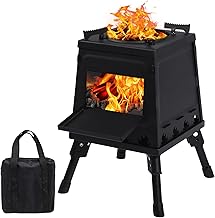
Best for ultralight backpackers who still want reliable campfire cooking. This cast iron stove is durable, rustproof, and designed to endure long-term use in rugged outdoor settings. Its 16 air vents promote efficient burning, and the large combustion chamber supports 40–60 minutes of burn time per load of firewood. The adjustable pot supports accommodate various cookware, and foldable legs enhance stability on uneven ground.
Who it’s best for: hikers and backpackers needing compact, durable wood heat with quick setup for boiling water or simple meals. Why selected: a balanced combination of durability, burn efficiency, and portable design. Caution: cast iron adds weight and bulk compared to lighter options.
Upgraded Portable Wood Stove for Camping

Best for tent campers who prioritize airtight combustion and a roomy firebox for longer burn times. This stove emphasizes high airtightness to minimize smoke leakage while ensuring complete combustion. Constructed from heavy-duty steel, it resists high heat without warping, delivering consistent performance through extended outings. The large firebox supports longer cooking and heating sessions in one session.
Who it’s best for: campers who stay in tents for extended periods and need dependable heat with reduced smoke. Why selected: robust construction and practical firebox capacity. Caution: heavier than some ultra-portable options, which may affect packing weight.
Stainless Steel Tent Stove

Best for hot tent setups and extended cold-weather trips where durable insulation and heat retention matter. This model uses a dual-layer insulated panel design with a 1.5mm stainless body for improved heat management and durability. It supports enhanced airflow for better combustion and has a wide range of compatibility with standard chimney configurations.
Who it’s best for: expeditions in cold environments needing reliable warmth with stable airflow. Why selected: strong insulation and corrosion-resistant construction. Caution: stainless steel can conduct heat quickly, requiring careful handling to avoid burns.
Upgraded Hot Tent Stove

Best for heavy-duty camp setups and ice-fishing trips that require robust chimney assembly and durable construction. The seven-section roll-edge chimney simplifies setup, while the reinforced door frame and airtight body optimize burn control. Tempered glass offers heat visibility for monitoring the fire. Choose this if you need strong performance in challenging environments. Caution: setup complexity may be higher than simpler stove models.
Large Tent Stove for Outdoor Cooking

Best for group cooks and BBQ-style outdoor meals. This large tent stove focuses on a spacious firebox and robust construction to handle bigger wood loads and longer cooking sessions. It includes a stainless steel firebox and chimney setup to support stable heat and good airflow. Choose this if you regularly host meals outdoors with friends or family. Caution: larger footprint may require more packing space and setup time.
Buying Guide: Outdoor Wood Stoves
- Durability vs. portability: How important is ultra-lightweight carry versus long-term durability in rugged conditions?
- Firebox size and fuel efficiency: Do you need a large firebox for extended cooking, or a compact design for quick boils?
- Airtightness and smoke control: Is minimizing smoke leakage a priority for tent camping?
- Material and heat management: Should you prioritize stainless steel for durability or cast iron for heat retention?
- Setup complexity: Are you comfortable with chimneys and door frames, or do you prefer simpler assemblies?
- Compatibility and accessories: Do you need compatibility with standard chimney systems or included carrying cases?
Practical advice: For backcountry trips with mixed cooking needs, prioritize a stove with a balance of portability and burn efficiency. For cold-weather camping, a robust, well-insulated model helps maximize heat retention and safety. Consider the terrain where you’ll cook; some stoves require stable, flat ground to avoid tipping.
FAQ
- What is the best wood stove for backpacking?
– A stove combining durability, light weight, and efficient burn, like the Lineslife Camp Stove, is well-suited for backpacking. - Do wood stoves require a chimney?
– Some models include or support chimney options for better airflow and heat control, while others are more compact without a chimney. - Can I cook with a wood stove in a tent?
– Yes, with a high-airtight model designed for tents, and proper ventilation and setup to avoid smoke buildup. - What materials are best for outdoor stoves?
– Stainless steel offers corrosion resistance and durability; cast iron provides excellent heat retention but adds weight. - Are larger stoves harder to transport?
– Generally yes; larger fireboxes and chimneys increase packing space and weight, but offer longer burn times. - Should I worry about soot and residue?
– Proper airflow and dry firewood reduce soot; choose stoves with good ventilation to minimize buildup.