
Searching for a vertical micro wind turbine that fits tight spaces or DIY projects? This guide highlights five compact options that suit boats, classrooms, small cabins, and hobbyist installations. Each choice is evaluated for best use cases, installation ease, and potential limitations. The top picks cover portable demonstrations, educational kits, and low-noise designs to support simple wind-powered experiments or small off-grid setups. The brief table below helps compare core details at a glance.
| Product | Best For | Key Advantage |
|---|---|---|
| Axis Wind Turbine Generator 3 Blades with Controller | Home units and small cabins | Three-phase PM generator with rust/moisture resistance |
| 2 Pcs DC 0.1V-5.5V Micro Turbines | DIY enthusiasts and classrooms | Compact, DIY assembly, wind power teaching tool |
| Micro Wind Turbines, DIY Vertical-Axis | Easy-to-install projects | Aerodynamic, low vibration, easy carry |
| 1 pcs DC 0.1V-5.5V Micro Generator | STEM demonstrations | Small, clear wind energy demonstration kit |
| EUDAX DIY Micro Wind Turbine | Education demos and experiments | Compact micro motor wind turbine generator |
Axis Wind Turbine Generator 3 Blades With Controller

Best for multi-use small installations. This 12V, 30W three-phase permanent magnet generator is suitable for boats, gazebos, cabins, homes, or light industrial tasks. It emphasizes rust and moisture resistance, stable operation, and good bearing wind resistance. The design supports DIY installation and aims for long life with efficient noise reduction. Ideal for users seeking a robust, mid-size micro turbine that can be integrated into simple off-grid or backup power projects.
Who it’s best for: DIY homeowners and small off-grid setups needing a weather-resistant rotor with straightforward installation.
Caution: The product notes that instruction resources may be limited; video guidance can be requested via message for those new to assembly.
2 Pcs DC 0.1V-5.5V Micro Vertical Wind Turbines

Best for classroom demonstrations or hands-on STEM projects. This kit features two micro wind turbines with a 5.5 V output and 4-vane fans at a compact 100 mm diameter. It’s a DIY-friendly model kit that fosters learning through assembly and experimentation. Suitable for wind power teaching experiments and small-scale demonstrations where students can observe basic turbine mechanics in action.
Who it’s best for: Students, educators, and hobbyists who want an approachable, small-scale wind power teaching tool.
Limitation: Requires user assembly; not a ready-to-run unit out of the box.
Micro Wind Turbines, DIY Vertical-Axis
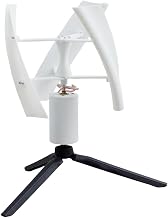
Best for compact installations with easy mounting. This vertical-axis design emphasizes a small footprint, low running vibration, and a high wind energy collection rate. Made with environmentally friendly 3D-printed PAL material, it’s noted for corrosion resistance and a streamlined look. It’s suitable for quick demos or small off-grid experiments where space is limited and portability matters.
Who it’s best for: Makers and DIYers seeking a lightweight, easy-to-mount turbine with a focus on portability and energy collection efficiency.
Limitation: The data suggests a focus on basic performance; high-output expectations should align with wind availability.
1 Pcs DC 0.1V-5.5V Micro Generator

Best for science classrooms and simple wind energy demonstrations. This compact generator is designed as an educational wind turbine kit, suitable for teaching concepts of wind power and energy conversion. It supports hands-on learning and is easy to display in school projects or science fairs.
Who it’s best for: Educators and students looking for a small-scale, visual wind power demonstration tool.
Limitation: It is a demonstration device, not a heavy-duty power source.
EUDAX DIY DC Power Micro Motor Wind Turbine

Best for education demos and small experiments. This micro motor wind turbine generator is presented as a DIY educational model. It lists voltage and RPM specs across several levels, making it suitable for illustrating how wind speed translates to electrical output. It’s a compact choice for teachers and students exploring wind energy basics.
Who it’s best for: Education-focused projects requiring a straightforward micro wind turbine demonstration model.
Limitation: Specific performance figures are environment-dependent and may vary with wind conditions.
Buying Guide
- Application context: Choose a turbine that matches your setting—educational use, small off-grid cabin power, or a demo display. Classroom kits favor simpler assembly and clear demonstrations, while cabin or boat setups benefit from rust/moisture resistance and durable bearings.
- Power needs vs. wind site: For low-wind areas, prefer designs with lower cut-in speeds and efficient energy capture. Higher output units require steady wind and sturdier installation.
- Installation and maintenance: Consider whether you want a plug-and-play unit or a DIY project that requires assembly. Look for clear instructions and accessible parts for long-term maintenance.
- Noise and vibration: If the turbine will be used near living spaces, prioritize models with low noise and stable operation to minimize disturbance.
- Materials and durability: Rust and moisture resistance are essential for outdoor use. Material choices influence longevity in humid or salty environments.
- Educational value: For learning-focused purchases, kits with adjustable components and measurable outputs (voltage, RPM) help demonstrate wind power concepts clearly.
Frequently Asked Questions
- What is the best vertical micro wind turbine for DIY projects? A unit with clear assembly steps, accessible components, and straightforward electrical output is ideal for DIY projects and learning demonstrations.
- Do vertical-axis turbines work well in low wind? Yes, some vertical-axis designs are engineered to start with lower wind speeds, making them suitable for mild winds. Check the stated cut-in wind speed when available.
- Are these turbines quiet? Many micro turbines emphasize low noise. If noise is critical, review the product’s noise characteristics and enclosure design.
- Can these turbines power a small device? Most compact designs generate modest voltage and current. They’re best for demonstrations, charging small batteries, or powering low-demand devices in ideal wind conditions.
- Do I need professional installation? For outdoor installations exposed to weather, ensure proper mounting and weatherproofing. Some kits are DIY-friendly, while others may benefit from basic technical support.
- What maintenance is required? Routine checks for corrosion, bearing wear, and loose connections help extend turbine life, especially in marine or humid environments.