
Yes—these robotic lawn mowers are designed to handle a 1/2 acre (about 21,780 sq ft) without wired perimeters. This guide highlights five models that excel in medium to larger suburban lawns, with features like LiDAR, RTK navigation, AI obstacle avoidance, and wire-free setup. The buyers most often interested in this range are homeowners seeking hands-off mowing, those with uneven terrain or shade, and anyone who wants precise edging or slope capability. The table below summarizes key details to compare quickly.
| Product | Navigation & Mapping | Best For | Limitations |
|---|---|---|---|
| ECOVACS Goat A2000 LiDAR PRO | HoloScope 360° Dual-LiDAR; edge trimming | Yards with trees or shade; edge-to-edge cutting | Higher price; 32V platform may require robust power |
| WORX Landroid WR320 | Vision Cloud AI; RTK cloud navigation | Complex shapes; accurate mapping from day one | Depends on cloud; requires internet access |
| Sunseeker Sunseeker X5 AWD | RTK + Vision Navigation; all-terrain AWD | Slopes and uneven ground; larger lawns | All-terrain features may add cost |
| Segway Navimow i105N | RTK + Vision AI; virtual boundary | Quiet operation; multi-zone management | Perimeter-free; may require setup for boundaries |
| MOVA LiDAX Ultra 2000 | 360° LiDAR + AI Vision; auto-mapping | Edge precision; large zones with complex borders | Newer model; may have fewer third-party accessories |
ECOVACS Goat A2000 LiDAR PRO Review

The ECOVACS Goat A2000 LiDAR PRO uses a wire-free LiDAR system for precise yard mapping, performing edge trimming with TruEdge and handling dense or shaded areas. It’s built on a strong 32V platform to tackle thick grasses common in American lawns. This model is best for buyers who want accurate mapping without installing perimeter wires and who value clean borders along drives and beds. A potential limitation is higher upfront cost and the need for sufficient power for extended mowing sessions.
WORX WR320 Landroid Vision Review

The WORX Landroid WR320 leverages Vision Cloud AI with RTK-based navigation for precise auto-mapping and thorough edge-following. It is well-suited for lawns with irregular shapes and changes over time, offering robust obstacle avoidance and cloud-based path planning. Choose this if you want strong mapping from day one and are comfortable relying on cloud services for updates. A limitation is dependence on a stable internet connection for optimal operation.
Sunseeker X5 AWD Review

The Sunseeker X5 AWD combines RTK and Vision AI with all-terrain AWD tires to manage up to 0.5-acre yards, including slopes up to 30 degrees. It’s best for homeowners with uneven ground, roots, or changing terrain who still want reliable robot mowing with strong obstacle detection. It may be less ideal for very small, highly flat lawns due to its broader capability set and potential weight.
Segway Navimow i105N Review
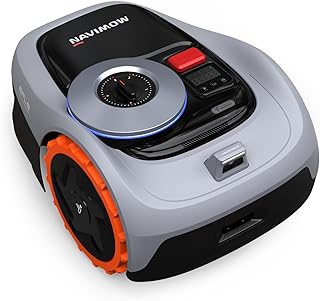
The Segway Navimow i105N uses RTK plus AI Vision with virtual boundaries for multi-zone management and quiet operation. Best for users who value precise boundary control and multi-area mowing with minimal perimeter setup. A caveat is that some users may need to configure virtual boundaries effectively for optimal performance.
MOVA LiDAX Ultra 2000 Overview

The MOVA LiDAX Ultra 2000 features 360° 3D LiDAR and AI Vision for auto-mapping without wires, delivering low-edge cutting within 2 inches of borders. It supports 0.5-acre mowing with 150 zones, and includes anti-theft features. This model is best for buyers who want precise 3D mapping and aggressive edge performance. A potential limitation is the newer platform, which may have fewer established third-party accessories.
Buying Guide: Key Considerations For 1/2 Acre Robotic Mowers
- Navigation technology: LiDAR, RTK, and AI Vision each offer strengths. LiDAR excels in shade and complex borders; RTK provides centimeter-level precision; AI Vision helps object recognition and path planning. Choose based on yard complexity and internet access.
- Border setup: Wire-free models rely on sensors and mapping; consider edge accuracy and edge trimming capabilities. If precise edging is critical, prioritize models with TruEdge or UltraTrim features.
- Terrain and slope handling: For lawns with slopes, AWD or robust suspension improves stability. Check the maximum slope rating and wheel design for your yard’s challenges.
- Yard shape and size: Autos mapping works best for irregular shapes. Ensure the mower can map multi-zone layouts if your yard has burdensome borders or islands.
- Connectivity and updates: Cloud-based mapping or app controls may require internet access. Consider offline capabilities if your location has spotty connectivity.
Frequently Asked Questions
- Do I need perimeter wires for a half-acre lawn?
Not necessarily. Several models in this range operate wire-free using LiDAR, RTK, or AI vision to map and navigate without boundary wires.
- What is RTK, and why does it matter for a 0.5-acre yard?
RTK stands for Real-Time Kinematic positioning. It provides centimeter-level accuracy for navigation, which helps at the edges and in complex yards with minimal overlaps or misses.
- Are wire-free mowers suitable for shaded areas?
Yes, many wire-free models use LiDAR and AI vision to map under trees and in shade, maintaining precise mowing in dim conditions.
- Can these mowers handle slopes?
Yes, several options include all-terrain wheels and suspension designed for slopes; check the specified maximum slope for each model.
- Will cloud-based navigation incur ongoing costs?
Some models rely on cloud processing for mapping and updates. There may be no direct per-month costs, but internet access and potential service tiers could affect performance.
- What type of edging accuracy should I expect?
Edges can be very close to borders with dedicated edge-trimming features or UltraTrim systems, typically within a couple of inches.