
Wood deck rubber coatings provide a durable, waterproof membrane that protects against peeling, cracking, and moisture. This guide highlights five top options that are especially well-suited for wood decks, docks, and porches. Each pick is analyzed for who it’s best for, how it’s applied, and key trade-offs. Use this overview to compare long-term protection, grip, and aesthetics. The selections favor coatings that promise high durability, flexibility, and compatibility with common outdoor substrates.
| Product | Best For | Finish | Size |
|---|---|---|---|
| Liquid Rubber Polyurethane Deck Coating – Textured, Beige | High-traffic wet areas; docks; stairs | Textured | 4 Gallon |
| Liquid Rubber Polyurethane Deck Coating – Smooth, Saddle Brown | Barefoot-friendly patios; low slip | Smooth | 4 Gallon |
| Liquid Rubber Polyurethane Deck Coating – Smooth, Saddle Brown | General decking with barefoot traffic | Smooth | 1 Gallon |
| Liquid Rubber Polyurethane Deck Coating – Textured, Stone Grey | Wet or high-traffic stairs | Textured | 1 Gallon |
| Liquid Rubber Multipurpose Primer for Concrete, Wood, Metal | Prep and adhesion boost | Clear | 1 Gallon |
Liquid Rubber Texture Deck Coating, Beige
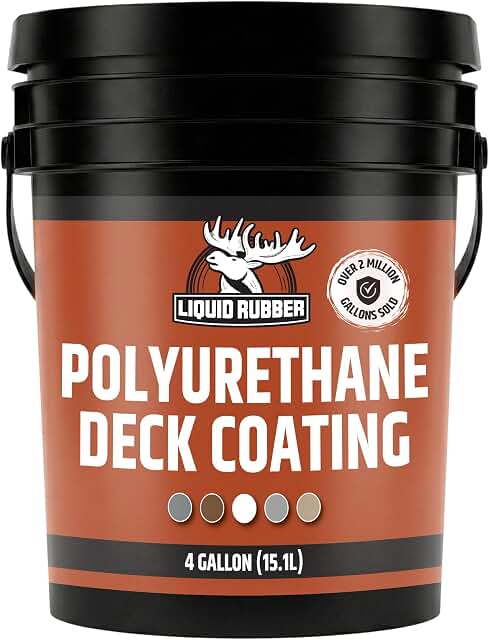
This textured finish adds extra grip, ideal for wet areas and stairs. The product forms a flexible polyurethane membrane that bonds to properly prepared wood, concrete, and metal. It claims to be 10X stronger than traditional deck paint, offering long-lasting waterproof protection for decks, docks, patios, and porches. Best for: high-traffic outdoor spaces where slip resistance is important, especially in damp climates. Limitation: final color may vary slightly after curing based on substrate and thickness.
Liquid Rubber Smooth Deck Coating, Saddle Brown
This smooth finish offers barefoot-friendly comfort while maintaining waterproof protection. It bonds to wood, concrete, plywood, and properly prepared metal surfaces to create a hard, flexible membrane. Best for: decks and patios where a smooth, slip-resistant surface is preferred for foot traffic. Caution: color appearance can shift slightly when wet and may differ from the cured finish depending on lighting and substrate.
Liquid Rubber Smooth Deck Coating, Saddle Brown (1 Gallon)

This 1-gallon option is designed for manageable projects or smaller decks, while still delivering a durable, waterproof membrane. It’s suitable for bare-foot traffic areas and works with wood, concrete, and metal substrates following proper surface preparation. Best for: homeowners or contractors tackling mid-sized decks who want a smooth, comfortable finish. Limitation: larger decks may require multiple cans and more coatings to achieve uniform coverage.
Liquid Rubber Textured Deck Coating, Stone Grey
This textured option is tailored for wet or high-traffic areas, offering an extra grip. It bonds to wood, concrete, plywood, and properly prepared metal substrates, forming a durable waterproof layer. Best for: steps and wet zones where additional traction is beneficial. Caution: color and texture may appear different when wet versus cured; thickness affects final shade.
Liquid Rubber Multipurpose Primer

This primer is designed to boost adhesion on concrete, wood, metal, and other substrates, helping prevent blistering and improving topcoat performance. Best for: prep before applying deck coatings, especially on challenging surfaces. Limitation: not a stand-alone finish; it’s an adjunct for better bonding.
Buying Guide
Key purchase considerations help determine the best wood deck rubber coating for a given project.
- Application area and climate: For wet zones or stairs, textured finishes with extra grip are advantageous. For barefoot patios, a smooth, pleasant feel is preferred.
- Substrate readiness: Wood decks require proper cleaning, dry conditions, and abraded surfaces for optimal adhesion. Concrete or metal substrates may need additional preparation steps.
- Durability vs. appearance: Textured coatings emphasize grip and longevity in outdoor environments, while smooth finishes prioritize aesthetics and barefoot comfort.
- Maintenance and color: Expect color variance post-curing. Consider light exposure, substrate color, and thickness when planning color matching.
- Primer role: Incorporating a multi-purpose primer can improve adhesion, especially on challenging surfaces. Use when recommended by the coating system.
Practical Buying Tips
- Choose the right size based on deck area and desired coating thickness. Larger projects benefit from 4-gallon options.
- Estimate slip resistance needs by zone: textured finishes for wet or high-traffic areas; smooth finishes for flat, low-slip zones.
- Plan for even coverage: multiple coats may be needed to achieve uniform color and membrane thickness.
- Follow curing times and environmental guidelines to maximize adhesion and durability.
FAQ
- Q: Can these coatings be applied over existing paint or stain?
- Q: Are these products safe for bare feet on patios?
- Q: Do I need a primer?
- Q: How long does curing take before the area can be used?
- Q: Will color match with existing deck colors?
- Q: Is the product waterproof after curing?
A: Yes, with proper surface preparation, including cleaning, dulling glossy surfaces, and allowing full curing of old coatings.
A: Smooth finishes are designed for barefoot traffic, while textured finishes provide additional grip in wet areas.
A: A primer is recommended when adhesion might be an issue or on difficult substrates to improve topcoat performance.
A: Curing times vary by product and climate; follow the manufacturer’s guidance for tack-free and full cure conditions.
A: Final color can vary based on substrate, thickness, and lighting; test on a small area if color matching is critical.
A: The coatings are designed to form a waterproof membrane when properly applied and cured.