
This guide highlights top 400-watt solar panels that suit off-grid setups, RVs, camping, and portable power stations. Each option balances high efficiency, portability, and weather resilience to help you choose the right panel for demanding outdoor use.
| Product | Brand | Key Highlight |
|---|---|---|
| EF ECOFLOW 400W Portable Solar Panel | EF ECOFLOW | High performance, IP68, foldable |
| Renogy 400 Watt Solar Panel Suitcase | Renogy | Portable, 23% efficiency, durable |
| Renogy ShadowFlux 400W N-Type | Renogy | Anti-shading, 25% efficiency |
| Anker SOLIX PS400 | Anker | Adjustable kickstand, IP67 |
| Callsun N-Type 16BB 400W | Callsun | Bifold, 25% efficiency, bifacial capable |
Note: All products listed are 400-watt class panels suited for portable power stations, RVs, camping, and off-grid systems. They vary in folding design, efficiency technology, and weatherproof ratings to meet different outdoor needs.
EF ECOFLOW 400W Portable Solar Panel Review
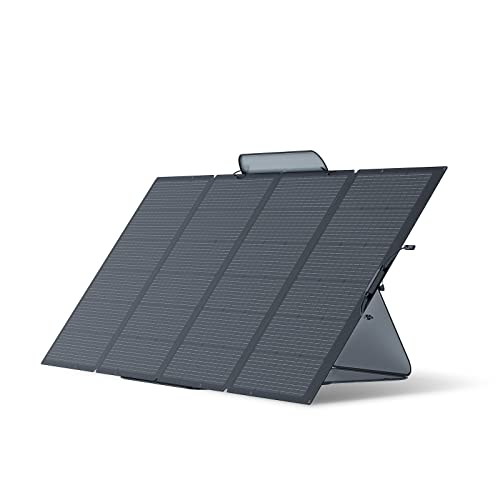
The EF ECOFLOW 400W solar panel delivers a high input capacity for powering portable stations, with a foldable design that supports easy transport. It weighs about 16 kg (35.3 lbs) and includes an adjustable kickstand case for angled sun exposure. Built to withstand outdoor use, the panel uses layers of flexible EVA and fiberglass and is rated IP68 for dust and water resistance, making it suitable for rugged adventures and unpredictable conditions.
Key features include a 400W input for substantial energy delivery, portability through folding design, and weatherproof construction to support outdoor deployments, such as camping trips or off-grid setups with compatible energy storage.
Renogy 400 Watt Solar Panel Suitcase

Renogy’s 400W panel suitcase is designed for RVs, camping, and off-grid power with a compact foldable form. At about 30.2 lbs, it collapses to 33.7″ x 27.95″ with a carry case for easy transport. The surface uses ETFE coating and fiberglass-reinforced construction for durability, delivering up to 23% efficiency with 16BB-based cells. The system supports quick setup, robust kickstands, and IP68-rated connectors for reliable connections to portable power stations.
Renogy ShadowFlux 400W N-Type Solar Panel

This Renogy model uses ShadowFlux anti-shading technology to reduce hotspots and improve energy yield in partially shaded conditions. It features 16BB N-Type cells for 25% efficiency, which helps with high-energy performance in challenging environments. The panels are compact and lighter than some PERC options, supporting space-conscious installations while maintaining solid power output for RVs, boats, and off-grid setups.
Callsun N-Type 16BB 400W Solar Panels

Callsun offers a 2-pack of 200W panels, totaling 400W, built with N-Type 16BB cells for up to 25% efficiency. The bifacial capability allows rear-side energy capture, boosting overall output by up to 30% under the right conditions. With anti-shading twin-cell design, each half can operate independently if one portion is shaded, improving reliability in variable light.
Anker SOLIX PS400 Solar Panel

The Anker SOLIX PS400 provides a foldable, portable 400W solar solution with an IP67 rating for weather resistance. It features adjustable kickstands that enable four angle settings (30°, 40°, 50°, 80°) to optimize sun exposure. The panel uses a robust ETFE coating for outdoor durability and a polymer composite interior to protect battery systems, aiming for reliable performance during camping, outdoor events, or emergencies.
Buying Guide: Key Purchase Considerations
- Power needs and compatibility: Match panel wattage to your energy storage and expected daily usage. Consider whether you need single-panel capacity or multi-panel configurations.
- Portability vs. durability: Folding and suitcase designs prioritize transport, while rigid panels may offer rugged build for harsh environments. Look at weight, dimensions, and carrying accessories.
- Cell technology and efficiency: N-Type and bifacial technologies can improve performance in partial shade and high-temperature conditions. Efficiency percentages (e.g., 23-25%) affect energy yield per square foot.
- Weatherproofing and durability: IP ratings (IP65, IP67, IP68) indicate resistance to dust and water. ETFE coatings and fiberglass reinforcement extend lifespan in outdoor use.
- Mounting and compatibility: Check kickstand versatility, mounting holes, bracket compatibility, and connector types for your power station or vehicle.
- Shade tolerance and shading mitigation: Anti-shading technologies reduce hot spots and performance loss when panels are partially shaded.
- Warranty and service: A robust warranty supports long-term reliability; consider manufacturer reputation and replacement policies.
- System integration: Ensure the panel can connect to your existing power station or battery system via compatible connectors and voltage ranges (12V/24V, MPPT compatibility).