
Finding affordable, reliable solar-powered electric fence chargers helps protect livestock, gardens, and property without ongoing electricity costs. This guide highlights five budget-friendly options, showing who each product is best for, how they perform, and practical limits. Ideal buyers include small farms, backyard homesteads, poultry keepers, or gardeners seeking simple perimeter protection. Below is a quick summary table of the five choices to help you compare at a glance.
| Product | Best For | Key Benefit |
|---|---|---|
| 24-Hour Solar Electric Fence Charger (0.18J) – 10 Mile | Small to mid-size livestock, predator deterrence | Continuous day/night operation with portable design |
| LD02 Solar Electric Fence Charger (1.2J) – 45 Mile | Medium to large livestock, long fence lines | High energy output for stronger containment |
| 10 Miles Solar Powered Electric Fence Charger (0.18J) | Garden borders, small pets, portable setups | Ultra-portable and versatile power options |
| 20 Miles Solar Powered Electric Fence Charger (0.33J) | Medium farms, larger gardens, mixed livestock | Adjustable voltage with built-in alarm |
| 30 Miles/48km Solar Electric Fence Charger (0.3J–1.5J) | Large properties, deer control, multi-area fencing | Wide coverage and multi-level output |
24-Hour Solar Electric Fence Charger, 0.18J, 10-Mile for Livestock

This charger provides a consistent 0.18 joule pulse suitable for containing cattle, goats, poultry, and deterring predators like raccoons and foxes. It operates with a built-in large-capacity battery, storing energy by day to energize the fence at night, ensuring 24/7 operation. Best for small to mid-size livestock setups where a portable, weatherproof unit is beneficial. A practical limitation is the three-rod grounding setup and soil conditions: very dry or rocky soil may require additional grounding rods for optimal performance.
Best for: Small farms or homesteads needing reliable day-night protection and a compact, weatherproof charger.
Who this is for: Buyers seeking a low-profile, solar-powered option with continuous operation without daily charging. The unit suits mobile fencing setups where livestock control and predator deterrence are priorities, and where a basic 0.18J output suffices.
LD02 Solar Electric Fence Charger LD02, 1.2J with Short Circuit Alarm

This charger delivers 1.2 joules of stored energy with a stable 7–11 kV pulse, designed for larger livestock like cattle, horses, and goats. It includes a short circuit alarm and long runtime via a solar panel plus backup power, supporting reliable performance along long fence lines. Best for farms needing stronger containment and a safety alert during faults. Limitation: the higher energy and alarm features may exceed the needs of very small or minimalist installations.
Best for: Medium to large fencing projects where stronger shocks and fault warnings improve security.
Who this is for: Buyers seeking improved deterrence and a reliable alarm system to notify of circuit issues or miswiring.
Limitations: As with any higher-energy system, ensure animals are appropriately conditioned and compliant with local regulations; the unit’s complexity may require careful setup.
10 Miles Solar Powered Electric Fence Charger, 0.18J
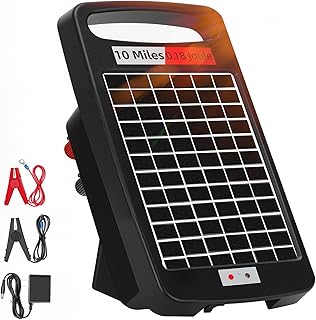
This portable charger emphasizes convenience, designed for quick relocation between fences. It provides day-night protection and stores enough charge to run through the night, making it a good pick for gardens, chicken coops, or small patch fences. Best for movable boundaries and temporary perimeter setups. A potential drawback is the relatively lower energy at 0.18J, which might be less effective for larger livestock or longer fence lines.
Best for: Garden borders, small pets, or temporary fencing needs where mobility matters.
Who this is for: Buyers with frequent fence reconfigurations who still want dependable 24/7 protection without heavy equipment.
Limitations: Not ideal for very large livestock or long, high-stress fence lines due to its modest energy output.
20 Miles Solar Powered Electric Fence Charger, 0.33J

This device features dual smart alarms with a 110 dB detachable siren for immediate alerts if the circuit is compromised. It offers 3-in-1 adjustable voltage with 8,000V, 9,000V, and 10,200V states to tailor power for various animals. It also boasts a long 14-day battery backup, maintaining protection during cloudy weather. Best for farms needing continuous surveillance and adjustable output for different livestock. Limitation: higher energy and alarm features may be more than needed for very small operations.
Best for: Farms seeking enhanced security features and adjustable voltage for diverse animals.
Who this is for: Buyers wanting audible alerts and longer backup power to keep perimeter protection during bad weather.
Limitations: The louder alarm and higher voltage options should be used with attention to livestock sensitivity and local guidelines.
30 Miles/48km Solar Electric Fence Charger, 0.3J–1.5J

Engineered for extensive properties, this unit powers fences up to 30 miles with four adjustable outputs from 6KV (0.3J) to 12KV (1.5J). It includes a professional LCD showing output voltage and battery level, enabling precise energy management. Best for large farms, deer fencing, or multi-zone setups where a single device covers wide areas. A potential caveat is the need for proper installation and monitoring due to higher power and longer fence requirements.
Who this is for: Buyers with large properties needing one-device, high-capacity perimeter protection and clear energy readouts.
Buying Guide: Key Considerations for Cheap Solar Electric Fences
- Fence length and livestock type: Align joule output and voltage with your animals and fence distance. Larger livestock and longer fences require higher output.
- Power source and backup: Consider panels, internal batteries, and backup options to ensure 24/7 operation in poor weather.
- Grounding and installation: Proper grounding improves effectiveness. Dry or rocky soil may need additional rods; ensure spacing recommendations are followed.
- Alarms and monitoring: Short-circuit alarms add safety, especially for larger properties; evaluate whether you need audible alerts.
- Portability vs. permanence: Portable units suit movable fences; permanent setups benefit from higher-output models with LCD readouts.
- Maintenance and weather resistance: Look for weatherproof enclosures and corrosion-resistant components for longevity.
Frequently Asked Questions
- What determines a good solar fence charger for small farms?
A balance of energy output (joules), voltage, and reliability for day-night operation across your fence length. - Is a higher joule rating always better?
Not always; higher joules suit larger animals and longer fences, but can be unnecessary for small setups and may consume more power. - Do solar chargers work well in cloudy climates?
Yes, with sufficient battery storage and panel capacity to store daytime energy for nighttime use. - What maintenance is required?
Regularly inspect grounding, inspect wires and connections, and check battery and panel cleanliness and integrity. - When should I upgrade from a 0.18J to a higher output unit?
If you have larger livestock, longer fences, or persistent predator pressure that a lower-output unit cannot deter.