
Finding the best chlorine feeder for your pool depends on your pool type, tablet size, and how often you want to refill. This guide highlights five reliable feeders suited for in-ground and above-ground pools, spas, and hot tubs. It helps you decide who each product is best for, with clear pros, best-use cases, and a practical buying table.
| Product | Best For | Capacity | Installation Type |
|---|---|---|---|
| Hayward CL200EF | In-ground pools; long intervals between refills | Up to 9 lb | In-line |
| Merkia Pool Chlorine Floater | Indoor/outdoor pools and hot tubs needing flexible release | 4 tablets | Floating |
| Merkia Pool Chlorine Floater (Collapsible) | Portable setups; easy storage | 4 tablets | Floating |
| Hydrotools by Swimline 87502 | Universal compatibility; aboveground or in-ground | 9 lb | Inline replacement |
| R171096 Pool Chlorinator (E-cowlboy) | Replacement for Rainbow Pentair setups; large gallons | Up to 98 small / 11 large tablets | Inline |
Pool Chlorine Floater, 7.5″ Large Floating Dispenser

Best for flexible chlorine delivery in both indoor and outdoor pools and hot tubs. This large floating dispenser uses an adjustable release mechanism to balance chlorine delivery as water conditions change, ensuring broad coverage across pool corners. It is made of durable ABS plastic for extended use. Capacity allows up to four 3″ tablets or sticks at once. Caution: tablets are not included, so plan refills accordingly.
Pool Chlorine Floater For 3″ Tablets (Collapsible)

Better for portable pool setups or seasonal pools where storage space matters. This collapsible design keeps the same features as a standard floater: floating performance, adjustable release, and capacity for up to four 3″ tablets. Best for owners who value compact storage and easy transport. Tablets are not included.
R171096 Pool Chlorinator (Inline)

Best for replacement in Rainbow 320 and Pentair setups with wide capacity coverage. It handles a broad range of pool sizes, from mid to large volumes, with an automatic flow control valve for steady output. Its compatibility and flexible feed range make it a solid inline choice for many in-ground pools. Caution: verify compatibility with your existing plumbing before installing.
HYDROTOOLS By SWIMLINE 87502 In-Line Feeder

Best for universal compatibility with both above-ground and in-ground pools. This 9 lb capacity feeder offers a straightforward dial to adjust output, enabling a consistent sanitation cycle with minimal manual monitoring. It works smoothly with chlorine and bromine tablets. Limitation: ensure proper laddering or plumbing match with your pool system before purchasing.
SWIMLINE Hydrotools 87501 Economy In-Line Feeder
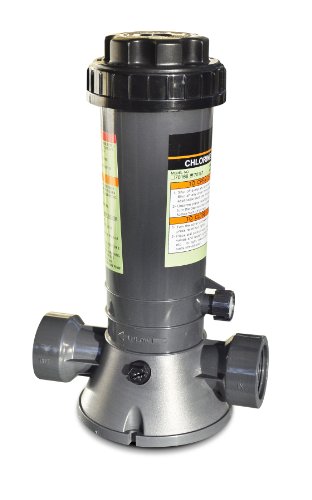
Best for budget-conscious buyers who still need reliable inline chlorine delivery. It features automatic chlorine distribution, a 360° adjustment dial, and universal compatibility. It’s a practical option for beginners or households balancing cost with consistent sanitation. Caution: performance depends on pump and filtration compatibility.
Buying Guide
Pool chlorine feeders come in floating and inline designs. Choose floating feeders for simple, portable setups and hot tubs, where you want quick, adjustable release and no installation. Inline feeders suit larger, fixed systems where you prefer a steady, hands-off chlorine feed integrated with your filter/pump.
What size pool do you have?
Inline feeders usually serve fixed plumbing for in-ground pools and larger spaces; floating feeders are ideal for smaller or above-ground setups and seasonal needs.
What tablets will you use?
Most feeders support 3″ tablets; some models also handle sticks or bromine. Confirm tablet type to ensure proper fit and dosing.
How much maintenance can you handle?
Feeder design affects maintenance. Floating devices require monitoring for tablet depletion and movement; inline feeders require occasional calibration and valve adjustments for consistent flow.
Installation and compatibility
Inline models must match your pool’s return lines and plumbing. Universal or compatible designs simplify installation, but always verify fit with your pump and filter configuration.
Best practices for using chlorine feeders
- Regularly check water chemistry to maintain safe sanitizer levels.
- Keep tablets dry and within manufacturer guidelines to prevent clumping and clogging.
- Inspect seals and lids to prevent leaks and corrosion over time.
FAQ
- What is the difference between a floating and inline chlorine feeder?
– Floating feeders sit on the water surface and release chlorine without installation, while inline feeders are installed in-line with the pool’s plumbing for continuous feed. - Can I use bromine tablets in chlorine feeders?
– Some feeders support both chlorine and bromine; check the product features and compatibility before use. - How often should I refill chlorine tablets?
– Refilling frequency depends on pool size, tablet size, and dosage settings. Monitor chlorine levels and adjust as needed. - Are there safety concerns with automatic chlorine feeders?
– Follow manufacturer instructions, keep lids closed, and store tablets away from children and pets. - Will a larger feeder reduce maintenance?
– A larger capacity reduces refills but may require more precise calibration to maintain balanced chemistry.