
Indoor growing hinges on precise climate control, especially carbon dioxide (CO2) levels. The right CO2 controller can automate regulators, fans, and vents to sustain ideal ppm ranges, conserve energy, and promote robust growth. This guide reviews five top CO2 controllers commonly used in grow tents, rooms, and greenhouses. Each option prioritizes accuracy, ease of use, and intelligent features to help you maintain a stable environment with minimal supervision.
Summary of Selected Products
| Product | Brand | Key Features |
|---|---|---|
| Inkbird ICC-510 CO2 Controller | Inkbird | Dual outputs, intelligent light sensor, universal 100–240V |
| AC Infinity Controller AI+ with CO2 Sensor Bundle | AC Infinity | AI learning, CO2 data tracking, temp/humidity/VPD, Bluetooth & WiFi app |
| AC Infinity CO2 Controller, Smart Outlet | AC Infinity | Two-plug system, adjustable CO2 and fan controls |
| Autopilot CO2 Monitor & Controller | Autopilot | Customizable deadband, trend chart, ppm analysis |
| Inkbird ICC-500T CO2 Controller | Inkbird | Double outlets, programmable CO2 range, plug-n-play operation |
Inkbird ICC-510 CO2 Controller: Dual Output, Smart Light Sensor

The Inkbird ICC-510 combines dual outputs with a smart light sensor, enabling automatic adjustments to CO2 output based on photosynthetic activity. This makes it suitable for grow tents and rooms where light cycles influence CO2 demand. The universal power supply (100–240V AC) supports use in different regions, simplifying installations in shared grow spaces or multi-zone setups. Users can connect a CO2 regulator and inline exhaust separately, optimizing both CO2 delivery and air exchange. Dimensional efficiency and straightforward calibration help minimize setup time, while the sensor-driven logic supports energy-conscious operation.
Potential advantages include energy savings during low-light periods, predictable CO2 delivery aligned with plant needs, and broad compatibility across climates. For growers seeking a reliable, budget-conscious controller with essential automation features, the ICC-510 provides a balanced mix of precision and simplicity. Note that, like all CO2 controllers, accuracy depends on sensor placement and calibration frequency.
AC Infinity AI+ With CO2 Sensor Bundle

AC Infinity’s AI+-driven controller introduces learning capabilities to tighten CO2 control while tracking CO2 data, temperature, humidity, and VPD. This bundle emphasizes adaptive regulation, using machine learning to anticipate spikes and modulate output for precise environmental stability. The system integrates with a Bluetooth and WiFi app, enabling remote monitoring and adjustments. As a result, growers can optimize fresh air exchange (FAE) and reduce energy use while maintaining target CO2 levels. It is well-suited for growers who prioritize data-driven decision making and long-term environmental consistency.
Strengths include proactive climate management, detailed data logging, and seamless connectivity for remote oversight. This option may appeal to enthusiasts and commercial grows seeking automation that learns from climate patterns rather than relying solely on fixed setpoints. Users should ensure stable network access for uninterrupted app-based control, and consider initial calibration to align with local CO2 sources and room dynamics.
AC Infinity Smart Outlet CO2 Controller

This AC Infinity model focuses on coordinated smart-outlet control for CO2 and exhaust systems. It is designed to optimize indoor environments by independently programming CO2 regulators and exhaust fans. The controller supports custom CO2 and fan programming that can dynamically alternate based on measured CO2 levels. The advantage is simple, scalable automation that translates directly into energy efficiency, particularly in larger grow rooms or multi-zone setups. It is a practical choice for growers who want straightforward scheduling with reliable sensor feedback without advanced AI features.
Users should consider room size, regulator compatibility, and the number of devices to automate, ensuring enough outlet channels for all connected equipment. While not featuring extensive AI capabilities, this unit provides dependable, hands-off operation and clear feedback from the CO2 readings to the grower’s dashboard or regular checks.
Autopilot CO2 Monitor & Controller

Autopilot’s CO2 Monitor & Controller emphasizes customizable ppm deadbands and a robust trend chart for ongoing CO2 analysis. The device records levels per minute, hour, and day, supporting precise tuning for growth stages or environmental shifts. With trend zoom capabilities, growers can trace ppm distribution and identify patterns related to lighting, ventilation cycles, or regulator performance. The setup is straightforward, allowing adjustments to ppm targets and deadbands to refine control. This makes it well-suited for growers who rely on historical data to inform environmental decisions.
Considerations include data visibility for debugging or optimization and ensuring the sensor is well-positioned away from direct airflow to avoid skewed readings. While not as feature-rich in AI or cloud analytics as some premium models, the Autopilot option delivers dependable performance for growers who value detailed monitoring and clear historical insights.
Inkbird ICC-500T CO2 Controller
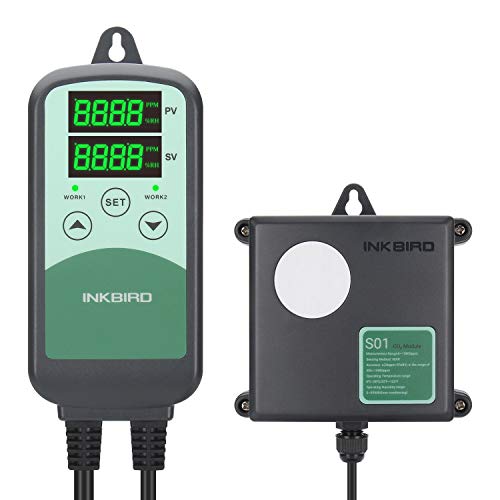
The ICC-500T expands on Inkbird’s practical design by offering double outlets for dedicated CO2 regulators and exhaust fans. Programmability allows users to set CO2 ppm targets and alarms, with automatic on/off control based on reaching the desired CO2 level. The plug-and-play nature reduces setup complexity, making it a strong option for hobbyists and small-to-medium grows. Having two outlets supports a straightforward two-device automation approach, enabling you to manage supply and air exchange without additional hubs or adapters.
Key considerations include calibration frequency for maintaining accurate readings and ensuring the connected CO2 equipment matches the controller’s load capacities. Overall, this model balances convenience with reliable control, suitable for growers who want a compact, easily managed solution that still delivers solid performance in CO2 management.
DANOPLUS CO2 Controller Dual Outlets

DANOPLUS offers a dual-outlet CO2 controller with a dual-beam NDIR sensor for accurate CO2 readings and long-term stability. The unit supports independent control of CO2 equipment and exhaust fans, enabling a tailored approach to maintaining ideal levels. A practical feature is its simple interface with two knobs to set high and low borders, removing the need for complex zone calculations. The controller also displays CO2, temperature, and relative humidity readings, providing a quick environmental snapshot at a glance.
As a solution, it suits growers who want a straightforward setup with clear on/off logic and reliable monitoring. The dual-sensor design and user-friendly interface can reduce time spent tweaking settings, while still allowing detailed monitoring and alarms for safety and workflow planning.
Buying Guide: Key Purchase Considerations
- Control scope: Decide whether you need single-room automation or multi-zone control. Units with multiple outlets better support larger grows or separate CO2 and ventilation equipment.
- Sensor accuracy: Look for devices with NDIR sensors for CO2 accuracy and stability. Check stated ppm accuracy and drift specifications.
- Automation features: AI-driven learning, programmable deadbands, and data logging add depth to control. Consider whether you want remote access via Bluetooth or WiFi for monitoring.
- Integration: Ensure compatibility with your existing regulators, inline fans, and exhaust systems. Universal power supply helps with cross-regional use.
- Alarms and safety: Audible alarms and clear readings help prevent over- or under-notification of CO2 levels, protecting plant health and equipment.
- Ease of setup: Plug-and-play models appeal to beginners, while feature-rich units may require more initial calibration and setup.
- Data visualization: Trend charts and logging support optimization over plant growth stages. Quick insights can guide lighting schedules and vent timings.
- Build and durability: A compact footprint with solid wiring and weather resistance (where applicable) ensures dependable operation in grow environments.
In sum, the best CO2 controller for a grow room balances precision, automation depth, and ease of use. For hobbyists, a model with straightforward setup and dual outlets may suffice, while advanced growers may benefit from AI-enabled controllers with robust data analytics and remote monitoring capabilities. Consider room size, equipment compatibility, and your desired level of automation when choosing the right device for your grow operation.