
Choosing the right full spectrum grow light can maximize growth, yield, and plant health for indoor gardening. The following selections represent a mix of reliable brands, wattages, and feature sets designed to meet various space and plant needs—from seed starting to leafy greens and flowering crops. Each product section below summarizes key capabilities and how they compare for different growth stages.
Summary Of Selected Products
| Product | Brand | Key Highlight | Approximate Coverage / Use |
|---|---|---|---|
| SANSI Grow Lights for Indoor Plants Full Spectrum | SANSI | Optical lens for high PPFD; long life | Seed starting and early vegetative growth |
| LEOTER Grow Light for Indoor Plants | LEOTER | 80 LEDs with multiple spectral modes; built-in timer | General indoor gardening; versatile stages |
| GooingTop LED Grow Light | GooingTop | High CRI (95); adjustable timer | Compact setups; reading/desk-style grow light |
| yentbokj Grow Lights for Indoor Plants | yentbokj | Four heads; adjustable tripod; RF remote | Larger plant sets; flexible height and angle |
| Briignite Grow Light Bulbs (A19) | Briignite | Full spectrum with 100W equivalent; energy saver | Standard light sockets; supplemental lighting |
SANSI Full Spectrum Grow Light Bulb

The SANSI 4000K daylight bulb imitates the solar spectrum from 400nm to 780nm, providing a near-natural color rendering with Ra close to 100. Its secondary optical design delivers a PPF of 65.6 μmol/s and a PPFD of 265.58 μmol/s per square meter at 1 foot, helping plants receive uniform supplemental light. A ceramic-on-substrate heat sink supports better thermal performance, prolonging bulb life up to around 25,000 hours. This option suits seedling stages and vegetative growth when compact fixtures are preferred.
LEOTER Full Spectrum Grow Light with Timer
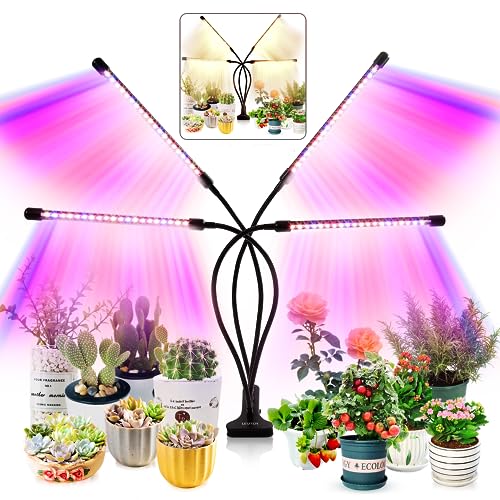
LEOTER offers an upgraded 80-LED fixture that includes a mix of red, blue, and full spectrum LEDs. It supports full spectrum coverage (380nm-800nm) with separate red/blue channels, plus a 3/9/12-hour timer with memory function. Ten brightness levels and three spectral modes help tailor light for rooting, vegetative growth, and flowering. A flexible gooseneck and a stable base make placement straightforward for desks, shelves, or small grow areas.
GooingTop Full Spectrum Grow Light

GooingTop’s clip-on grow light uses 10 red and 74 white LEDs, with a 6000K white light closely resembling noonday sun. It features a high color rendering index (CRI) around 95, ensuring accurate plant color signals and healthy photosynthesis. A timer with 4/8/12-hour options supports consistent daily cycles, while the gooseneck and clamp provide easy positioning for small to medium plant setups. It can run via USB or AC power for flexible placement.
yentbokj 4-Head Grow Light with Tripod
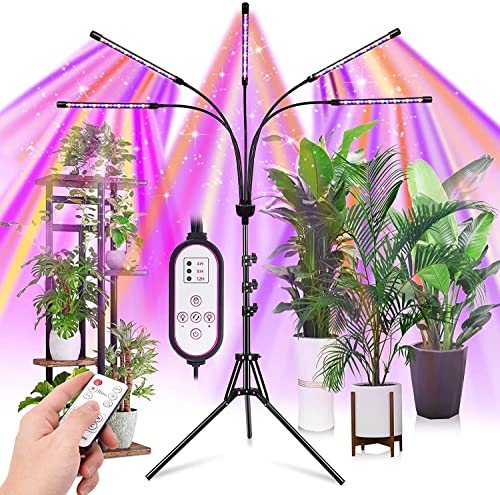
yentbokj provides a four-head full-spectrum setup with a height-adjustable tripod (15–63 inches) and 360-degree head rotation. It supports three spectral modes (Red+Blue, White, or White+Red+Blue) and ten dimming levels. Timing features include inline and RF remote control for auto on/off at 4/8/12 hours. Each LED head can be controlled independently, making it suitable for larger bench setups or rotating plant collections while addressing varied growth stages.
Aokrean 3-Pack Halo Grow Light

Aokrean’s halo-style grow lights offer three selectable spectrums (white, warm white, red) with a compact form factor. The stand supports indoor plant lighting with two installation modes—insert into soil or place on a stand. It includes a timer with 3/9/12-hour cycles and ten adjustable brightness levels. This modular option fits small grow spaces and experiments with different spectral mixes for early growth or maintenance of potted plants.
Plant Grow Light by Yadoker

Yadoker’s full spectrum light uses 72 LEDs across white, warm white, red, and blue channels to cover 380nm-800nm. Height is adjustable up to 61.1 inches, with a telescoping pole to fit tall plant varieties and larger spaces. Ten brightness levels allow fine-tuning from 10% to 100%, supporting all growth stages. The 5V low-safe voltage design adds an emphasis on safe indoor use for households and classrooms.
Briignite Full Spectrum A19 Grow Bulbs

Briignite’s A19 bulbs deliver a full spectrum with a dominant 4000K white appearance and integrated red/blue channels to support tomatoes, cucumbers, peppers, leafy greens, and herbs across growth stages. A 180-degree wide light pattern provides broad coverage while consuming only about 11 watts, equal to a traditional 100W bulb. The result is energy-efficient lighting with a practical PPF output for small to medium indoor gardens.
Buying Guide: Key Purchase Considerations
- Light spectrum and targets: Look for full-spectrum options spanning 380–800 nm, plus targeted red/blue channels for vegetative growth and flowering. A high CRI (near 90-95) helps plants appear healthy and can aid growers in evaluating plant condition.
- PPF and PPFD metrics: Higher photon flux (PPF) and photosynthetic photon flux density (PPFD) at a typical distance indicate stronger usable light. For seed starting and leafy greens, moderate PPFD (100–300 μmol/m²/s at 6–12 inches) is common; flowering crops often benefit from higher PPFD.
- Fixture form factor: Bulbs, panels, and multi-head arrangements each suit different spaces. Clip, clamp, tripod, or stand options determine placement flexibility and coverage area.
- Controls and timing: Built-in timers (daily cycle options like 4/8/12 hours) simplify routines, while dimming and spectral mode options help tailor light to growth stages and seasonal needs.
- Heat management: Efficient heat sinking (e.g., ceramic-based substrates) and quiet operation prolong lifespan and maintain stable light output.
- Power and safety: Check voltage compatibility, safety ratings, and whether the fixture uses USB, AC, or low-voltage power. Ensure the setup fits your space and is safe for indoor use.
- Cost of operation: While prices vary, consider energy efficiency and long-term bulb life to estimate operating costs across a plant’s life cycle.
- Scalability: For larger collections, multi-head units or tripod systems enable broad coverage without sacrificing intensity. For compact setups, a single high-CRI bulb or small panel may suffice.
These considerations can help balance performance, space, and budget. When selecting, align the light’s spectrum, intensity, and control features with your plant types and growth stages to optimize yields and plant quality.