
Choosing the right hydroponic grow light can extend growing seasons and boost yields in indoor setups. This guide examines five top options, focusing on spectrum quality, energy efficiency, coverage, and ease of use. Each product is evaluated for veg and bloom performance, heat management, and adaptiveness to common indoor spaces. Read on to compare features and decide which light best fits your hydroponic system and plant varieties.
Summary of selected products:
- BESTVA 2025 Upgrade DC1000 LED Grow Light — Full spectrum, high yield, two cultivation modes
- KingLED 2025 KP1000 LED Grow Light — 100W with three growth modes, strong PPFD for 2×2 ft
- TATU 1000W LED Grow Light — Full spectrum, energy efficient, quiet operation
- FREELICHT 4ft LED Grow Light — 60W, economical, scalable with multiple units
- LEOTER Upgraded Grow Light — 80 LEDs, multi-mode timer, adjustable spectrum
Bestva 2025 Upgrade DC1000 Led Grow Light

The BESTVA DC1000 LED grow light uses 640 high quality LEDs to deliver a bright full spectrum while consuming only about 100 watts. Marketed for 2×2 ft coverage with a maximum of 3×3 ft, it aims to balance high yield with low operating costs. The spectrum includes 3000K, 5000K, 460nm, and 660nm diodes to support vegetative growth and flowering stages. Two cultivation modes provide a flexible schedule: a long vegetative/seedling period and a shorter bloom phase. Its design emphasizes uniform light distribution and heat management suitable for compact grows.
Key features include high-yield efficiency, a full-spectrum approach close to natural sunlight, and selectable growth stages. The device targets hydroponic plant health with full-spectrum LEDs and a power-efficient footprint. For growers expanding to 2×2 ft tents, this model offers a simple upgrade path without increasing electricity usage dramatically. As with many LED fixtures, heat sinks and fanless options may influence placement in warmer rooms or taller stacks.
In practice, this light yields noticeably better leaf color and compact internodes for many leafy greens and herbs. It pairs well with reflective walls and a good ventilation strategy to prevent heat buildup in small grow areas.
KingLED 2025 KP1000 LED Grow Lights

The KP1000 from KingLED delivers 100W of LED output with a 640-LED array organized to provide a natural sun-like spectrum. Coverage up to 2×2 ft and a PPFD-friendly design make it suitable for compact hydroponic tents. The fixture provides a mix of blue, red, white, and yellow diodes, with a spectrum planning from 460 nm blue to 660 nm red, plus white light for a balanced, broad spectrum. Three modes—Veg, Bloom, and Veg&Bloom—let users tailor lighting to growth stage while preserving energy efficiency. It’s designed to be easy to install and adjust in small growth spaces.
Performance focus centers on yield optimization and light uniformity across the growing canopy. The light’s efficiency and long-term reliability appeal to hobbyists and small setups. The 2×2 ft target area aligns with many starter hydroponic tents, and the 100W draw helps control electricity costs while maintaining strong photosynthetic drive. Proper cooling and stable mounting are advised to prevent light intensity fluctuations during extended cycles.
Growers often report robust vegetative growth and steady flowering with this unit. Pair it with reflective surfaces and vertical space adjustments to maximize efficiency in limited spaces.
TATU 1000w LED Grow Light

TATU’s 1000W LED grow light emphasizes a full-spectrum design intended for all growth stages. The unit balances a broad spectrum with energy efficiency, offering a realistic alternative to traditional HPS lighting. The design highlights quiet operation and superior heat dissipation through a multi-side convection approach. With a cover designed to reduce heat buildup, it supports continuous operation in grow tents and home gardens. Growers with a focus on consistent flowering timelines may appreciate the stable, low-noise performance.
Key strengths include the spectrum’s inclusion of red and white channels to drive flowering and overall vigor, plus a design that minimizes heat while maintaining high light output. The fixture is suitable for hydroponic setups where space is limited but light intensity remains critical for productive yields. It’s compatible with standard mounting systems and can be daisy-chained with compatible units for larger rooms.
Performance notes emphasize steady PPFD delivery at closer distances, making it a common pick for 2×2 ft tents and compact hydroponic stations. As with any high-output LED, proper heat sinking and ambient temperature management help sustain long-term efficiency.
FREELICHT 4ft LED Grow Light

The FREELICHT 4ft LED grow light offers a 60W light that delivers an equivalent brightness to a 350W HPS fixture. It is designed for easy integration into a grow setup, supporting plants during seedling through vegetative stages and into flowering with supplemental lighting. The unit is marketed as energy-efficient, suitable for parallel installation of up to four lights, and adaptable to both hanging and surface-mounted configurations. It emphasizes a sunlike spectrum with added red light to augment photosynthesis and bloom potential.
For small to medium-scale operations, FREELICHT provides a cost-effective approach to expand light coverage without substantial electrical upgrades. The 4-foot length is advantageous for wall-mounted installations or across multiple bench spaces in a single room. It is best paired with reflective walls and careful distance control to prevent light burn while maintaining steady growth rates across the canopy.
The fixture maintains a user-friendly profile, enabling straightforward setup for hobbyists and urban growers. Because it’s designed to work in tandem with other units, it scales well for growing kits or modular tent configurations.
LEOTER Grow Light Upgraded Version
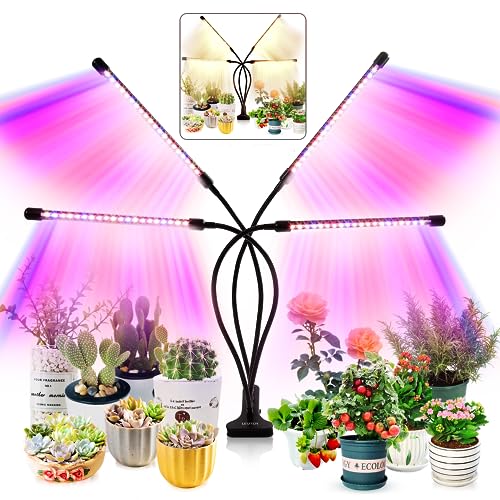
The LEOTER upgraded grow light features 80 LEDs with a full spectrum plus red/blue combinations to support diverse plant needs. It offers 3/9/12-hour timers and 10 dimmable levels, enabling precise control over lighting depending on plant stage and species. The adjustable gooseneck and three switch modes provide flexibility for positioning and mode selection, aiding seed germination, vegetative growth, and flowering in hydroponic environments. The compact form factor fits on desks, shelves, or small grow tents, making it suitable for hobbyists seeking a versatile light source.
LEOTER’s timer and spectrum options help optimize energy use while maintaining robust growth across a variety of indoor plants. The multi-mode operation allows growers to tailor day lengths and intensity to reduce stress on sensitive crops. The gooseneck design also simplifies angling for uniform canopy coverage.
Buying Guide: Key Purchase Considerations And Comparisons
- Spectrum quality: Look for lights offering full-spectrum or sunlike spectra that cover blue (veg) and red (flower) bands, plus white for balanced color rendering. Consider fixtures with both warm white and colored diodes for flexibility across growth stages.
- PPFD and coverage: Assess the footprint the light can effectively illuminate at typical distances. Vendors often cite coverage at 2×2 ft or 3×3 ft; verify whether your tent size and plant height align with the recommended distance range to avoid light starvation or scorching.
- Energy efficiency: Compare wattage against actual output. LED configs with multiple diodes can deliver higher photosynthetic efficiency per watt, reducing electricity costs over time.
- Heat management: Indoor setups benefit from good heat dissipation. Look for fixtures with aluminum heat sinks or convection design, especially in small tents where heat buildup can limit plant growth.
- Adjustability: Timers, dimming, and growth-stage modes help tailor light to plant needs. Multi-mode units enable longer life by letting you extend vegetative periods before blooming.
- Installation and compatibility: Check mounting options, daisy-chain capabilities, and compatibility with grow tents or shelving. Simple plug-and-play models are ideal for beginners, while modular systems suit expanding setups.
- Reliability and warranty: LED lifespans are long, but brands with solid warranties offer protection against early failure. Verify return policies and customer support quality when possible.
- Scalability: For future expansion, consider lights that can be chained or easily added in groups to maintain uniform canopy coverage across larger areas.
In selecting among these options, consider your space constraints, plant variety, and electricity budget. For beginners, starting with a 2×2 ft tent and a single fixture with Veg/Bloom modes can establish a stable baseline. For more seasoned growers, modular setups with multiple units and daisy chaining provide flexibility to optimize coverage and intensity as crops scale.