
If you need dependable RV fresh water pumps, these five options cover high flow, reliability, and smart automation for various RV setups. Perfect for full-time rigs, weekend campers, or small boats seeking steady water pressure, efficiency, and dry-run protection. The best pick depends on whether you need ultra-quiet operation, 12V off-grid capability, or 110V AC convenience.
Buying quick reference: the table below compares key specs for five top picks to help you decide at a glance.
| Product | Flow | Pressure | Power | Best For |
|---|---|---|---|---|
| Kohree 2026 Upgraded RV Water Pump | 7.5 GPM | 70 PSI | 12V DC | High-demand showers and sinks |
| WASSERMANN RV Pump | 4.0 GPM | 45 PSI | 12V DC | Budget, complete kit |
| ECO-WORTHY 33-Series 110V Pump | 4.0 GPM | 50 PSI | 110V AC | AC-powered setups without a battery |
| Hzhdven 7GPM 70PSI Five-Chamber Pump | 7.0 GPM | 70 PSI | 12V DC | Quiet, off-grid RVs |
| Kitvance 2026 Upgraded RV Pump | 6.0 GPM | 70 PSI | 12V DC | Run-dry protection, quiet operation |
Kohree 2026 Upgraded RV Fresh Water Pump

Best for high-demand RV systems. The 2026 model features an updated internal structure for more stable pressure and improved durability. It delivers 7.5 GPM at 70 PSI with a 12V DC motor, and includes a self-priming design with a five-chamber diaphragm. The pressure switch and strainer are built for consistent water flow, making it suitable for showers, sinks, and multiple outlets in larger RVs or marine applications.
Best for campers needing robust performance and quick response in a compact package. It’s well-suited for mid- to large-capacity RVs and boats that require steady pressure with minimal fluctuation.
Limitations may include installation space considerations due to its five-chamber design, and users should verify electrical draw matches their battery setup.
WASSERMANN RV Pump, 12V Self-Priming

Best for complete kit and easy upgrade. This model provides up to 4 GPM at 45 PSI with a full kit included (adapters, debris filter, manual). It’s designed for simple installation in RVs, campers, or yachts using a 12V DC power source. The included components help reduce additional purchases for a ready-to-install system.
Best for buyers seeking a value-forward package with ready-to-use fittings and a straightforward setup.
Limitation lower flow compared to high-demand setups, which may affect multi-head usage simultaneously.
ECO-WORTHY RV Fresh Water Pump 12V DC

Best for adjustable pressure on demand. This 12V pump provides 3.5 GPM at 45 PSI with a self-priming capability up to 9.8 feet and a lift up to 98 feet. It includes an on-demand pressure switch that turns on with faucet use and can adjust within 35-80 PSI. Thermal overload protection helps prevent motor damage if temperatures rise.
Best for RVs or small yachts that want flexible pressure settings without a heavy battery draw.
Limitation max flow is lower than some high-output models, so it’s ideal for lighter-use systems or fewer outlets.
ECO-WORTHY 33-Series 110V Pump
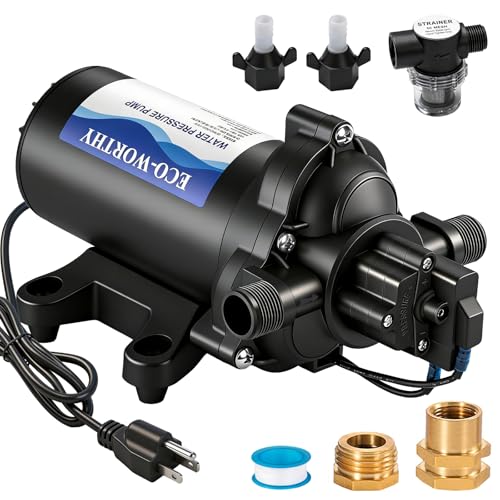
Best for AC-powered installations away from battery limits. The 110V AC diaphragm pump delivers 4.0 GPM at 50 PSI, with self-priming up to 9.8 ft and a lift up to 131 ft. It includes a smart pressure switch for on-demand operation and thermal overload protection for safety. It’s suitable for RVs with shore power or solar setups that can support AC appliances.
Best for setups where AC power is readily available and a battery-free option is desirable.
Limitation requires AC power; not suitable for strictly 12V off-grid configurations.
Kitvance 2026 Upgraded RV Pump

Best for quiet operation and dry-run safety. This 6.0 GPM pump offers up to 70 PSI with automatic pressure control and a self-priming capability up to 10 ft vertical and 155 ft horizontal. The NSK double ball bearings and five-chamber diaphragm emphasize quiet operation, reduced vibration, and durability for RVs, marine vessels, and campers.
Best for RV owners who prioritize quiet living spaces and long pump life in off-grid or mixed-use conditions.
Limitation slightly lower flow than the top 7 GPM models, which might matter for high-demand multi-head showers.
Buying Guide
What flow and pressure do you need?
Consider the number of fixtures and typical usage. A higher GPM (gallons per minute) supports multiple outlets simultaneously, while PSI determines shower firmness and appliance performance. For large rigs, aim for 6–7 GPM at 70 PSI or more.
12V DC vs 110V AC power
12V models excel in off-grid RVs with battery power, while 110V units are convenient when shore power is available. Some 12V units include smart switches to reduce cycling and save energy.
Self-priming and dry-run protection
Self-priming helps with installation flexibility. Dry-run protection and thermal overload protection extend motor life, especially in cold starts or during system bleeding.
Installation considerations
Check fittings, hose sizes, and space. A package that includes adapters and strainers reduces extra purchases. Evaluate whether you need a complete kit or a single pump for an upgrade.
Maintenance and components
Look for diaphragm durability, valve quality, and the availability of replacement parts. Five-chamber diaphragms typically deliver smoother flow and quieter operation in RV environments.
Safety and compatibility
Ensure electrical compatibility with your battery bank and fusing requirements. Follow wiring guidelines from the manual to avoid overloading circuits and ensure safe operation around water.
Who should consider these pumps?
- Full-time RV owners needing reliable daily water pressure
- Weekend campers with multi-head shower requirements
- Boat or yacht owners seeking compact, quiet, 12V systems
- RVers without easy access to shore power who rely on batteries
Quick reference checklist
- Target flow: 4–7.5 GPM based on fixtures
- Target pressure: 45–70 PSI
- Power source: 12V DC or 110V AC
- Dry-run protection and thermal protection
- Included adapters and filters
FAQ
- Q: Do I need a high-flow pump for RV showers?
- A: If you regularly run multiple outlets at once, a higher GPM (6–7) at around 70 PSI is beneficial; otherwise a 4–5 GPM unit may suffice.
- Q: Can I install a 110V pump in an RV that runs on battery?
- A: Yes, but you’ll need an inverter and adequate power capacity. 110V units aren’t ideal for off-grid use.
- Q: Is a five-chamber diaphragm quieter?
- A: Generally, yes. Five-chamber designs reduce vibration and pulsation for smoother operation.
- Q: What is dry-run protection?
- A: It allows the pump to run briefly without water without damaging the motor, extending lifespan in some scenarios.
- Q: Should I choose a pump with a built-in strainer?
- A: A built-in strainer helps protect the diaphragm and valves from debris, especially in older or poorly filtered water systems.