
Top salt pool test kits provide fast, reliable readings for salt levels, pH, chlorine, and related parameters. This guide helps American buyers choose kits that fit their budget, pool type, and maintenance routine. The best picks cater to homeowners with saltwater pools looking for simple, repeatable results, spa owners needing quick checks, and pros who want durable, long-lasting reagents. The table below summarizes five strong options and who they suit.
| Product | Best For | Why It Stands Out |
|---|---|---|
| Taylor K-2006-SALT FAS-DPD 9-in-1 (K-2006-SALT) | Serious saltwater pool owners, pro-grade testing | Comprehensive 9-parameter FAS-DPD kit with durable reagents |
| Salt-Water Pool Test Strips Kit: 125 Counts 8-in-1 | Budget-conscious households, quick checks | 8-in-1 strips with 125 tests and wide salt range |
| All-New 2026 Pool Salt Tester & pH Meter (5-in-1) | Digital readings for precise, multi-parameter needs | Versatile digital meter for salinity, pH, temp, EC & TDS |
| Pool Salt Tester & PH Meter (5 in 1) | Easy operation for everyday pool care | Simple 5-parameter digital tester with broad usage |
| All-New 2026 8-in-1 Pool Test Strips (150 CT) | All-around convenience for saltwater pools | 8-parameter strips with enhanced paper quality |
Notes: This article presents five products most relevant to the keyword “salt pool test kit.” Each entry includes buyer-focused guidance, practical cautions, and clarity about when to choose one option over another. Prices are not provided to keep the focus on value and fit for purpose.
Taylor K-2006-SALT FAS-DPD 9-in-1 Pool & Spa Test Kit

The Taylor K-2006-SALT kit is designed for saltwater pools and spas, offering nine core test parameters via FAS-DPD high-range testing. It includes a complete set of reagents and a storage case, making it ideal for households that want reliability and expansion capability over the season. Best for: diligent pool owners who test regularly and value a long-lasting reagent supply. Why selected: comprehensive 9-parameter coverage in one kit with clear instructions for non-technical users. Limitation: reagent replacements are sold separately, so ongoing maintenance costs should be considered.
Salt-Water Pool Test Strips Kit: 125 Counts 8-in-1

This 125-count kit provides an 8-in-1 strip-based approach, combining salt level with eight common pool parameters. It is particularly attractive for budget-minded owners who want a quick dip-and-read solution. Best for: homeowners who prefer rapid, on-the-spot checks without handling liquids. Why selected: high test count at a low price point and a practical color chart designed for saltwater ranges. Limitation: strips may be less precise than digital meters or FAS-DPD kits, especially for subtle parameter shifts.
All-New 2026 Pool Salt Tester & pH Meter | Digital 5-in-1
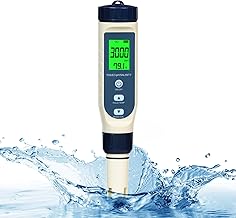
The All-New 2026 digital 5-in-1 measures salinity, pH, temperature, EC, and TDS. Its digital interface is designed for easy calibration and readouts, making it suitable for pool owners who want precise numbers without manual color matching. Best for: users who value exact digital readings and multi-parameter display in one device. Why selected: versatility across multiple water types and straightforward operation. Caution: calibration accuracy depends on proper calibration procedures and ensuring fresh reagents or calibration solutions are used when needed.
Pool Salt Tester & PH Meter, Hofun Digital 5-in-1

The Hofun 5-in-1 meter combines salinity, pH, temperature, EC, and TDS readings in one handheld device. It supports a wide range of applications beyond pools, including aquariums and hydroponics. Best for: users who want a single tool for multiple environments and quick toggling between salt and general water tests. Why selected: broad applicability and simple operation. Limitation: some users may need to rely on calibration checks to maintain optimal accuracy over time.
All-New 2026 8-in-1 Pool Test Strips – 150 CT

This 150-count package continues the 8-in-1 test strips tradition with enhanced paper quality for improved color stability and readability. It adds salt testing to the standard 7 parameters, making it a practical choice for saltwater pools. Best for: households needing a large supply of quick-test strips with reliable results. Why selected: high volume, improved strip quality, and the convenience of testing eight parameters in a single dip. Caution: color interpretation can still vary between lighting conditions; ensure consistent lighting when comparing results.
Buying Guide
- Test method versus digital accuracy: Digital meters deliver precise numerical values and are ideal for frequent testing or where exact ranges matter. Strips and reagents provide quick, low-cost checks and can be sufficient for routine maintenance.
- Parameter coverage: Consider which parameters you need. Most saltwater pool kits track free chlorine, total chlorine, pH, alkalinity, and cyanuric acid. Some add calcium hardness, salt, and temperature. Choose a kit aligned with your pool’s chemistry profile.
- Ease of use: For casual users, simple color charts or one-handed digital meters reduce setup complexity. For pros or advanced hobbyists, a 9-in-1 or 8-in-1 kit with clear instructions is valuable.
- Reagent availability and replacement: Some kits require ongoing replacements for reagents. Check availability and annual cost when budgeting.
- Kits with robust cases and clearly labeled reagents simplify seasonal maintenance and prevent mix-ups.
- If your pool’s salt concentration sits near upper or lower limits, ensure the kit’s measurement range covers your target levels and that the testing method minimizes color interpretation errors.
- Digital meters require calibration, battery care, and occasional probe care. Strips require proper storage to prevent moisture exposure and color fading.
How to Choose The Right Salt Pool Test Kit
Assess your pool type (in-ground vs. above-ground) and your maintenance habits. If you test weekly with multiple parameters, a 9-in-1 kit or a digital multi-parameter meter can streamline routines. If you want a low-cost backup or occasional checks, strips provide a quick snapshot. For households with more complex water management needs, a digital meter with auto-calibration and a broad measurement range offers the most flexibility.
Care and Maintenance Considerations
- Store reagents in a cool, dry place away from direct sunlight to preserve shelf life.
- Calibrate digital meters according to the manufacturer’s instructions, and replace calibration solutions as needed.
- After testing, rinse reagents and sample containers as appropriate to minimize residue interference in subsequent tests.
- Keep a simple testing log to track trends in salt level, pH, and chlorine over the season.
FAQ
- What is a salt pool test kit used for? It is used to measure salt concentration and other water-chemistry parameters to keep saltwater pools balanced and safe.
- Which kit is best for beginners? A kit with clear instructions, color charts, and simple steps—such as a salt test strip kit or a basic 5-in-1 digital meter—works well for beginners.
- Are digital meters more accurate than test strips? Digital meters provide numerical values and often higher precision, but the best choice depends on your testing routine and budget.
- Can I rely on test strips for spa management? Yes, many 8-in-1 or 7-in-1 strips cover spa water parameters, but ensure their test range includes spa-specific ranges.
- How often should I replace reagents? Reagent replacement depends on usage and shelf life; follow the kit’s guidance and store reagents properly to extend life.
- Do these kits measure cyanuric acid (CYA)? Some kits include CYA in their test parameters; verify which parameters are included in each kit’s list.