
Answer: This guide highlights compact pontoon setups powered by electric trolling motors, ideal for calm lakes and rivers. It helps buyers who want easy-to-maneuver, low-noise propulsion without gasoline engines. The top picks suit different boat sizes: from tight waterways to larger pontoons that demand more thrust. A quick summary table below shows key specs to compare at a glance.
| Product | Thrust | Shaft | Best For | Notes |
|---|---|---|---|---|
| Newport Pontoon-Series 55lb | 55 lb | 55″ | Medium pontoons | Balanced power and control |
| Newport L-Series 86lb | 86 lb | 40″ | Larger pontoons, longer runs | Highest power in this group |
| Newport NV-Series 62lb | 62 lb | 36″ | Jon boats and larger fishing boats | Good low-end torque |
| Minn Kota Pontoon Bow-Mount 55lb | 55 lb | 48″ | Pontoons with bow mount needs | PowerDrive foot pedal included on some models |
| Newport NV-Series 36lb | 36 lb | 30″ | Kayaks, canoes, small boats | Lightweight and portable |
What to expect: The options below cover a range of vessel sizes and use cases, from quiet, lightweight trolling for small craft to stronger setups for bigger pontoons. Buyers should consider boat length, desired speed, battery availability, and the environment (freshwater vs. saltwater) when choosing.
Newport Pontoon-Series 55lb Thrust Pontoon Trolling Motor

Features: 55lb thrust, 55″ fiberglass shaft, 66″ battery cable leads with ring connectors. This motor is designed for pontoon setups that need reliable all-day trolling with straightforward mounting and compatibility with standard transom hardware. Best for mid-sized pontoons that require steady, moderate power without excessive weight.
Best for: Pontoon owners seeking a solid balance of power and control for calm to moderately choppy inland waterways. It pairs well with typical marine batteries and standard transom brackets.
Why selected: It offers ample thrust for typical pontoon loads and a long shaft to clear deck obstructions. The 55″ shaft helps reduce prop entanglement and improves depth control, which is helpful on longer runs.
Caution: Verify boat transom compatibility with the included mounting hardware to ensure a secure fit, especially on older pontoons.
Newport L-Series 86lb Transom Trolling Motor

Features: 86lb thrust, 40″ shaft, LED battery indicator, 6″ telescoping tiller, 3-blade prop, adjustable mount height and direction, eight speeds (5 forward, 3 reverse).
Best for: Larger pontoons or those with heavier loads, where strong, quiet propulsion and long run times are needed in mixed-water conditions.
Why selected: The higher thrust and robust shaft make it better for longer trips and windy days, while the tiller and display help with precise control and monitoring.
Caution: Higher thrust can draw more battery power; plan battery capacity accordingly for all-day use.
Newport NV-Series 62lb Transom Trolling Motor

Features: 62lb thrust, 36″ shaft, saltwater-capable, 5-LED battery meter, 6″ telescoping tiller, 3-blade prop, adjustable mount. Eight speeds (5 forward, 3 reverse).
Best for: Jon boats and larger fishing boats that require reliable performance in varying water conditions, including saltwater environments.
Why selected: The 36″ shaft and robust construction provide good reach and stability, while the LED meter helps track battery status during longer outings.
Caution: Saltwater performance varies by prop and corrosion protection; ensure routine maintenance to avoid buildup in brackish waters.
Minn Kota Endura C2 50 Lb Transom Mount
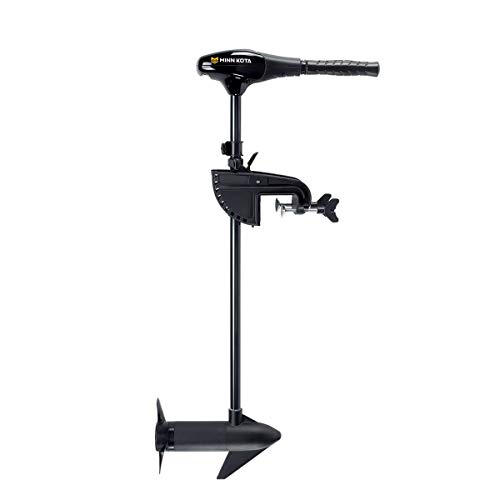
Features: Telescoping 6-inch tiller, push-to-test battery meter, 10-position lever lock bracket, reinforced composite construction, Power Prop for heavy vegetation, includes prop pin, nut, and washer.
Best for: Pontoon setups that need durable all-around performance with easy angle adjustment for fishing in weedy or flooded areas.
Why selected: The Endura C2 line remains a balanced choice for moderate pontoons seeking stability and straightforward installation.
Caution: The 50 lb thrust is mid-range; heavier pontoons or windy conditions may warrant higher thrust models.
Minn Kota Pontoon Bow-Mount Electric Trolling Motor

Features: 55 lb thrust, 48″ shaft, freshwater. Deploy-Assist lever, aluminum quick-release bracket, and a quiet locking system. Includes a responsive PowerDrive foot pedal (18 ft cord, GPS-enabled models excluded).
Best for: Pontoon owners who want bow-mounted propulsion for precise directional control and easy deployment on larger decks.
Why selected: The bow-mount design provides intuitive steering at the front of pontoons, which helps with tracking in calm waters and fishing zones.
Caution: Bow-mount installations may require additional deck space and mounting considerations on compact pontoons.
Buying Guide: Key Purchase Considerations
- Boat size and load: Heavier pontoons require higher thrust to maintain speed and maneuverability. Match motor thrust to boat weight and typical load.
- Shaft length: Longer shafts prevent motor from hitting the hull in waves and reduce the risk of prop strikes. Choose a shaft length that clears the waterline with the boat’s trim.
- Propeller design: A 3-blade propeller offers good low-end torque and smoother operation for calm waters; more blades may provide better acceleration but can add drag.
- Power source: Batteries vary in capacity and weight. Plan for all-day use by selecting a motor compatible with your battery bank and recharge plan.
- Mounting type: Transom-mount and bow-mount designs have different handling traits. Bow-mounts offer precise control near the boat’s front but require deck space; transom mounts are common and straightforward.
- Durability and environment: Saltwater-capable models include corrosion resistance. Freshwater use is common for inland pontoons but verify fittings and coatings.
- Controls and usability: Features like telescoping tiller, push-to-test meters, and LED battery indicators simplify operation and monitoring during trips.
FAQ
- What thrust is best for a small pontoon? Answer: For small pontoons, 36–62 lb thrust is typically adequate for calm lakes and light loads; larger pontoons may benefit from 55–86 lb thrust for stronger propulsion.
- Is a longer shaft always better? Answer: Not always. Longer shafts prevent cavitation and prop strike on chop, but they add weight and may complicate mounting. Choose based on hull height and waterline depth.
- Can I use a trolling motor in saltwater? Answer: Yes, many models are saltwater-capable with corrosion-resistant components. Check the propeller and housing for saltwater suitability.
- Should I get bow-mount or transom-mount? Answer: Bow-mounts offer precise front-end control and are good for pontoons with ample deck space; transom mounts are simpler and work well on most smaller boats.
- How do I know which battery to pair with my motor? Answer: Consider runtime needs, weight, and charging options. A higher-thrust motor typically requires a larger battery or battery bank for all-day use.
- Are these motors easy to install myself? Answer: Most transom- and bow-mount trolling motors are designed for straightforward installation with standard mounting brackets; some setups may benefit from professional mounting for optimal alignment.