Read the report before reading the fertilizer aisle
A soil test helps you decide whether the ground needs a nutrient or pH adjustment before you buy a product to solve an assumed problem. It does not tell you everything about a struggling plant, but it can keep you from treating the entire yard as if every bed had the same shortage.
Start by identifying the area and planting goal attached to the report. A recommendation for a vegetable bed is not automatically a recommendation for the lawn, the blueberry patch, or a newly planted shrub elsewhere on the property.
The University of Maryland explains that laboratory soil testing provides baseline information about pH, nutrients, and organic matter, with recommendations for fertilizer and pH adjustment. The tests included vary by laboratory, so read the package description rather than assuming every report contains the same measurements.
Keep the original report and the submission form together. If you later ask for help, the person reviewing them needs to know what you sampled and what you told the laboratory you planned to grow.
Make the sample match the question
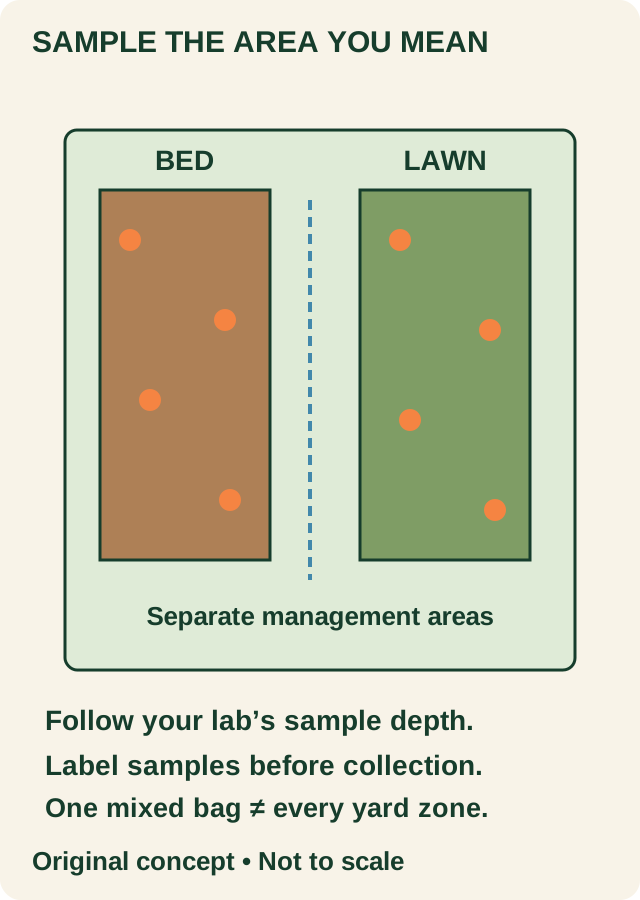
Read your chosen laboratory's current collection instructions before taking any soil. The required depth, number of subsamples, preparation, and quantity depend on the laboratory and intended use, so avoid combining several internet methods into one improvised procedure.
Divide visibly different or differently managed areas before sampling. If one bed has received years of compost while another is newly exposed subsoil, blending them may produce an average that describes neither place well enough for your decision.
Label samples before you go outside and use names you will recognize later. Back vegetable bed and shaded side lawn are more useful than sample one and sample two when the results arrive after your memory of the collection day has faded.
Tell the laboratory about unusual site history or suspected contamination and ask which additional tests are appropriate. A routine fertility panel is not proof that soil is free of lead or other contaminants, and edible gardening may require a different investigation.
Use pH as a matching question
Soil pH describes acidity or alkalinity, but the useful question is whether that result suits the plants you intend to grow. A number outside the target for one crop may be quite different from the target for another.
Read the laboratory's recommendation for your stated crop rather than chasing a universal perfect pH. If you entered the wrong crop or selected a broad category that does not fit your planting, ask the laboratory to clarify before applying an amendment.
Do not add lime simply because a neighbor uses it or because a lawn product bundle includes it. The amount and type should follow the relevant recommendation, and your actual area must be measured so the total application matches the stated rate.
If changing pH looks difficult or substantial, consider whether a different planting would suit the site better. That is a design choice you can compare calmly, rather than a requirement to keep adding products until an unsuitable plant becomes convenient.
Distinguish a nutrient rating from a shopping instruction
Reports may show a measured concentration, a category such as low or sufficient, and a separate application recommendation. These are related pieces of information, but the concentration is not a number you can copy straight onto a fertilizer spreader setting.
Look for the recommended nutrient amount, its units, the area basis, and any timing instructions. If a recommendation uses pounds per thousand square feet, calculate against the actual area you will treat rather than the total property size.
For a simple arithmetic example, a recommendation of one unit per thousand square feet corresponds to half a unit over five hundred square feet. This example explains scaling only; it does not prescribe a nutrient, rate, or product for your yard.
Then read the fertilizer label to determine how much product supplies the recommended nutrient amount. If you are uncertain about the conversion, ask the laboratory or Extension office to work through your exact report and label before application.
Do not turn sufficient into a preventive purchase
A nutrient rated sufficient does not become more useful simply because you can add it. Compare the recommendation with the ingredients in any blended fertilizer so you do not repeatedly apply nutrients that the report says are already adequate.
Maryland's soil-testing guidance connects testing with reducing overfertilization and protecting water quality. That matters when a convenient all-purpose product includes phosphorus or other nutrients you do not actually need in the sampled area.
Keep track of amendments as well as bagged fertilizer. Compost, manure-based products, and some combined lawn treatments contribute nutrients, so recording only the product sold under the word fertilizer leaves part of your management history invisible.
Write down the date, treated area, product, and actual amount used. A short record helps the next test explain change over time and prevents a second household member from repeating an application because the first one was never documented.
Put organic matter in context
Organic matter is useful information about the soil, but it is not a score you should raise without limit. Read it alongside your soil conditions, crop, amendment history, and the laboratory's interpretation.
The University of Maryland notes that organic matter is reported by weight, while amendments are often sold by volume. A percentage on a soil report therefore cannot be converted directly into a bag count without knowing more about the soil and intended treatment.
Before buying a large load of compost, ask what specific problem you want it to solve. Improving an exposed bed, topping up a container, and raising ground beside a foundation are different projects, and the same material is not automatically appropriate for all three.
Avoid burying existing trunks, crowns, or important drainage features while trying to improve a percentage. Where the proposed change affects established plants or finished grades, get planting or site-specific advice rather than treating the report as permission to add unlimited material.
Know which questions the report leaves open
A fertility test does not show exactly how water travels across your yard, whether a root ball is dry inside, or whether a plant has a disease. Pair the results with observations of light, moisture, planting depth, and the actual symptoms.
If the report looks reasonable but plants still struggle, resist ordering a stronger fertilizer by default. Photograph the whole planting and close details, note when the symptoms began, and ask an appropriate local adviser what other evidence would help.
Likewise, do not assume that a dark soil color proves fertility or that pale soil necessarily needs every nutrient. The report gives you measured information for the submitted sample, while appearance alone can encourage overly broad guesses.
Keep unusual results in perspective by checking the sample label and history first. An unexpected value may warrant a conversation about collection, recent amendments, or repeat sampling before you spend money correcting a result that does not fit the area.
Turn the result into a short action sheet
Write down what you will apply, where you will apply it, the calculated amount, and the timing specified by the recommendation and product label. Add a separate line for questions that remain unresolved rather than hiding them inside a shopping list.
Include the next review point, following the laboratory's advice about retesting. Repeating a test makes the most sense when collection and labeling are consistent enough that you can compare like areas instead of a new mixture of unrelated beds.
If the report recommends no application for a nutrient, record that decision too. Doing nothing because the evidence supports it is a useful management choice, especially when the garden center makes every shelf look like a problem you have forgotten to solve.
Your practical outcome is a smaller, more specific purchase and a clearer reason for using it. You are feeding the plants according to the measured site and stated goal, while leaving room to investigate problems that fertilizer cannot answer.
Sources & further reading
Exact documentation checked October 15, 2026. Original examples and illustrations; no hands-on product testing or professional certification claimed.
- Soil Testing and Soil Testing LabsLab tests provide pH/nutrient/organic-matter baselines and crop-specific recommendations; panels vary, additional contaminant testing is separate, and testing helps avoid overfertilization.
- Organic Matter and Soil AmendmentsOrganic matter is measured by weight, and amendment/feedstock history matters when interpreting additions.